Majority of Young Republicans Support Cutting Military Aid to Israel, Poll Reveals
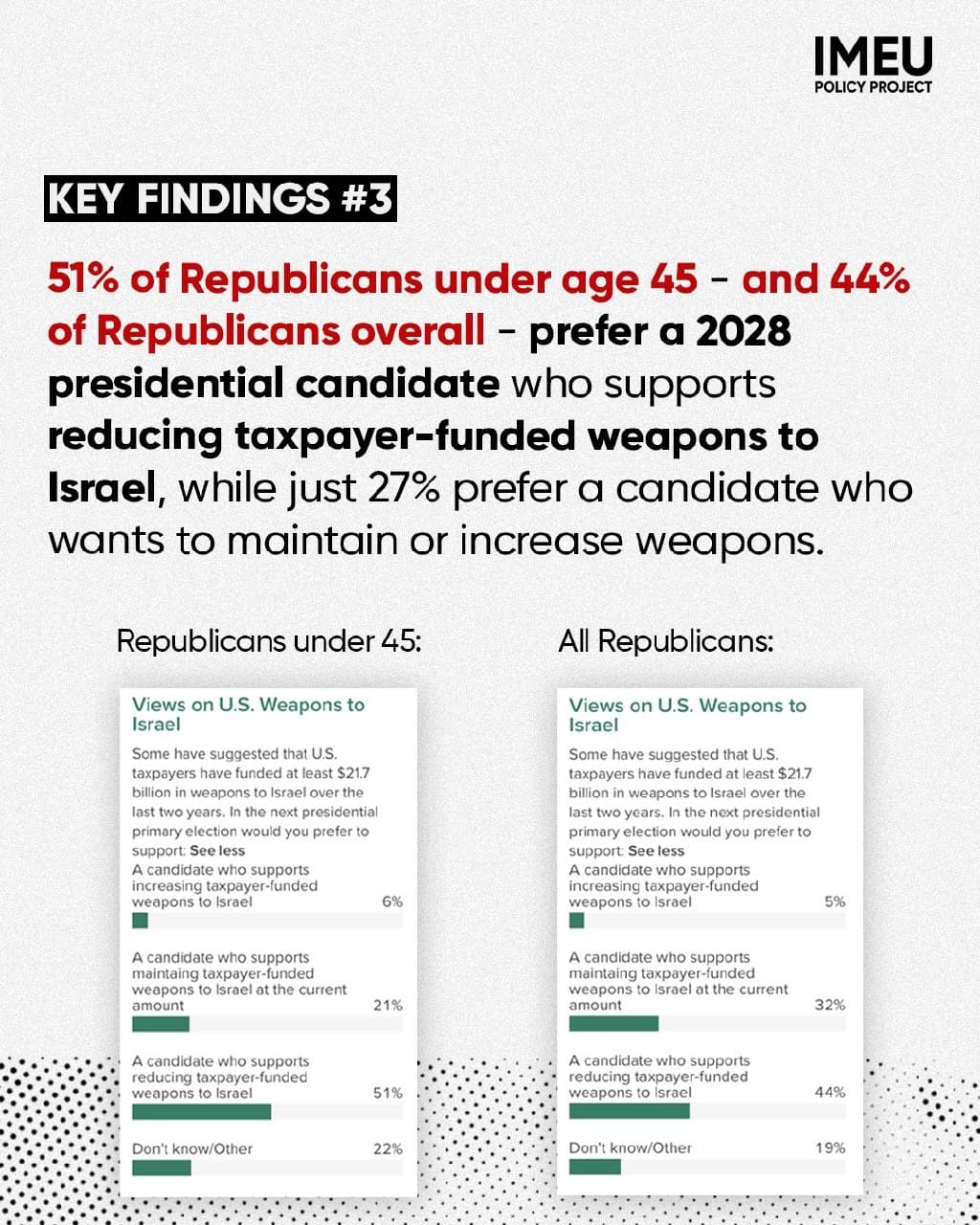
A recent YouGov poll conducted for the Institute for Middle East Understanding (IMEU) has revealed significant shifts in the attitudes of younger Republicans regarding U.S. military aid to Israel. The poll, which surveyed Republicans under the age of 45, found that 51% support a presidential candidate who would advocate for cutting military assistance to Israel, a notable stance given the historical bipartisan support for Israel in U.S. politics.
Key Details
The poll highlights that among Republicans under 45, 53% would prefer to allow the current “Memorandum of Understanding” (MOU) to expire without renewal. This MOU, which was established in 2016, provides Israel with $3.8 billion in military aid annually over a ten-year period. The current agreement is set to conclude in 2028, and the sentiments expressed by younger Republicans indicate a potential shift in policy direction as the expiration date approaches.
Additionally, 51% of younger Republicans oppose the 20-year, $76 billion aid deal that former President Donald Trump is currently negotiating with Israel. This deal, if finalized, would represent a significant increase in U.S. financial support for Israel, but the poll results suggest that a substantial portion of the party"s younger base is not in favor of such commitments.
The poll also indicates a broader trend among Republicans regarding priorities in governance. A majority, 52%, of all Republicans surveyed expressed a preference for a presidential nominee who prioritizes affordability for Americans over foreign aid to Israel. This reflects a growing concern among party members about domestic economic issues, potentially signaling a shift in focus for future Republican candidates.
Interestingly, the poll also revealed that 17% of Republicans would consider voting for a Democratic candidate if that candidate emphasized the economic welfare of Americans over the defense of Israel. This statistic underscores a potential opening for Democratic candidates to appeal to disaffected Republicans who prioritize domestic issues.
Furthermore, the poll addressed perceptions of free speech concerning criticism of Israel. A significant portion of Republicans, 48%, agree that legitimate criticism of Israel is often labeled as antisemitic, with 50% of Republicans under 45 and 47% of those over 45 sharing this view. Only 23% of Republicans disagreed with this sentiment, indicating a notable concern within the party regarding the boundaries of acceptable discourse on Israel.
Background
The findings from this poll come at a time of increasing scrutiny and debate over U.S. foreign aid policies, particularly in relation to Israel. Historically, U.S. military aid to Israel has been a cornerstone of American foreign policy in the Middle East, reflecting a commitment to Israel"s security. However, as domestic issues such as healthcare, education, and economic stability gain prominence among voters, particularly younger ones, the traditional support for foreign aid may be reevaluated.
The IMEU, which commissioned the poll, is a nonprofit organization that aims to provide accurate information about the Middle East and promote understanding of the Palestinian narrative. Their research often highlights the complexities of U.S. foreign policy and its implications for both domestic and international audiences.
What"s Next
The implications of these poll results could be significant for future Republican primaries and general elections. As younger voters increasingly prioritize domestic economic issues over foreign aid, candidates may need to adjust their platforms to resonate with this demographic. The potential for bipartisan support on issues related to military aid and economic welfare could reshape the political landscape in upcoming elections.
As previously reported, similar shifts in political attitudes have been observed in various contexts, including recent developments in foreign policy debates and domestic economic discussions. The evolving perspectives within the Republican Party may signal a broader trend that could influence U.S. policy towards Israel and other international allies in the years to come.


![[Video] Netanyahu and Kisch award Trump the Israel Prize for his contribution](/_next/image?url=%2Fapi%2Fimage%2Fthumbnails%2Fthumbnail-1767044599834-pgeqh-thumbnail.jpg&w=3840&q=75)
![[Video] Israeli army conducts demolition operations in Rafah, south Gaza](/_next/image?url=%2Fapi%2Fimage%2Fthumbnails%2Fthumbnail-1767121846051-l1pttg-thumbnail.jpg&w=3840&q=75)