Title: Arnaud Bertrand Compares Current US-Europe Relations to Sino-Soviet Split
Author: Jessica Martinez-Thompson
In a recent analysis, political commentator Arnaud Bertrand drew parallels between the current state of relations between the United States and Europe and the historical Sino-Soviet split of the 1960s. Bertrand"s observations highlight a significant ideological fracture that mirrors past geopolitical tensions, particularly in the context of the ongoing conflict in Ukraine and the evolving U.S. National Security Strategy under President Donald Trump.
Key Details
Bertrand noted that the Sino-Soviet split was primarily driven by ideological differences following Nikita Khrushchev"s policies of de-Stalinization and his advocacy for "peaceful coexistence" with the West. This shift led China, which was then considered a junior partner to the Soviet Union, to accuse the Soviets of being "revisionist traitors." Khrushchev"s approach aimed to avoid military confrontation while redirecting Soviet resources toward economic competition with the West, a strategy he believed would allow the USSR to "catch up and overtake" Western economies.
In a striking contemporary parallel, Bertrand pointed out that President Trump has expressed a desire for "peaceful coexistence" with Russia. The latest National Security Strategy (NSS) released by the Trump administration prioritizes the security of the U.S. homeland and the Western hemisphere, while redefining competition with China as primarily economic rather than military. The chapter on China in the NSS is titled "Win the Economic Future, Prevent Military Confrontation," echoing Khrushchev"s rhetoric almost verbatim.
Bertrand emphasized that European leaders, traditionally seen as junior partners to the U.S., now openly perceive the United States as "revisionists." This sentiment was articulated by Friedrich Merz, a prominent German politician, who stated that the era of "Pax Americana" has ended and that there is no point in nostalgia for it, framing U.S.-Europe relations as fundamentally adversarial. This statement is particularly notable given Merz"s affiliation with the Christian Democratic Union (CDU), a party historically known for its pro-U.S. stance.
The ongoing war in Ukraine, which has been exacerbated by the expansion of the transatlantic alliance, is seen as a critical factor in the deterioration of U.S.-European relations. Bertrand"s analysis suggests that the conflict, initially rooted in geopolitical tensions, is now contributing to the unraveling of the very alliances that were meant to counter such threats.
Background
Bertrand"s insights come at a time when the geopolitical landscape is shifting dramatically. The U.S. National Security Strategy has undergone radical changes compared to previous iterations, reflecting a significant pivot in American foreign policy. This shift raises questions about the future of U.S.-European relations and the broader implications for global stability.
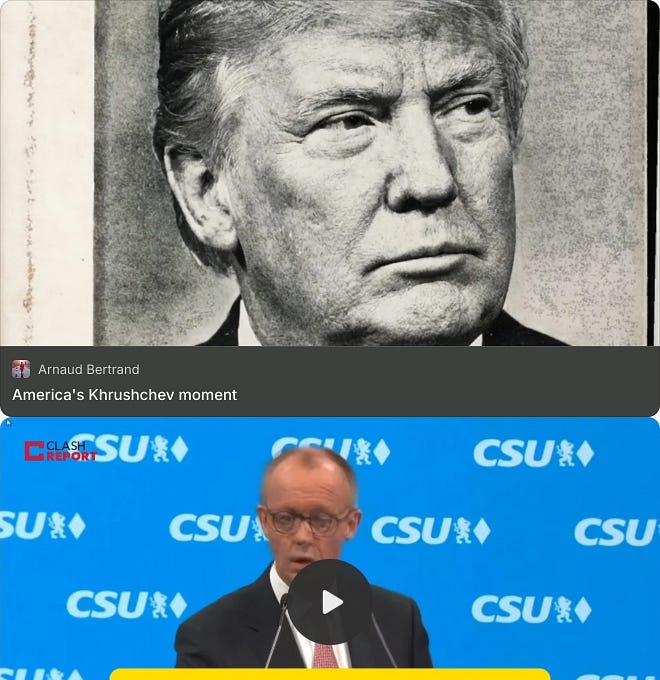
Image for Arnaud Bertrand compares current US-Europe relations to Sino-Soviet split
What"s Next
As Bertrand posits, the key question remains: if Trump is viewed as a modern-day Khrushchev, who will emerge as the Deng Xiaoping figure to navigate these turbulent waters? The implications of these dynamics are profound, as they could reshape the future of international relations, particularly in the context of U.S.-China competition and the evolving role of Europe on the global stage.
For further insights into this topic, readers can refer to the article "America"s Khrushchev Moment Discussed by Arnaud Bertrand", which delves deeper into the recent developments in U.S. foreign policy and its impact on global relations.