China condemns U.S. arms sales to Taiwan, warns of increased conflict risk
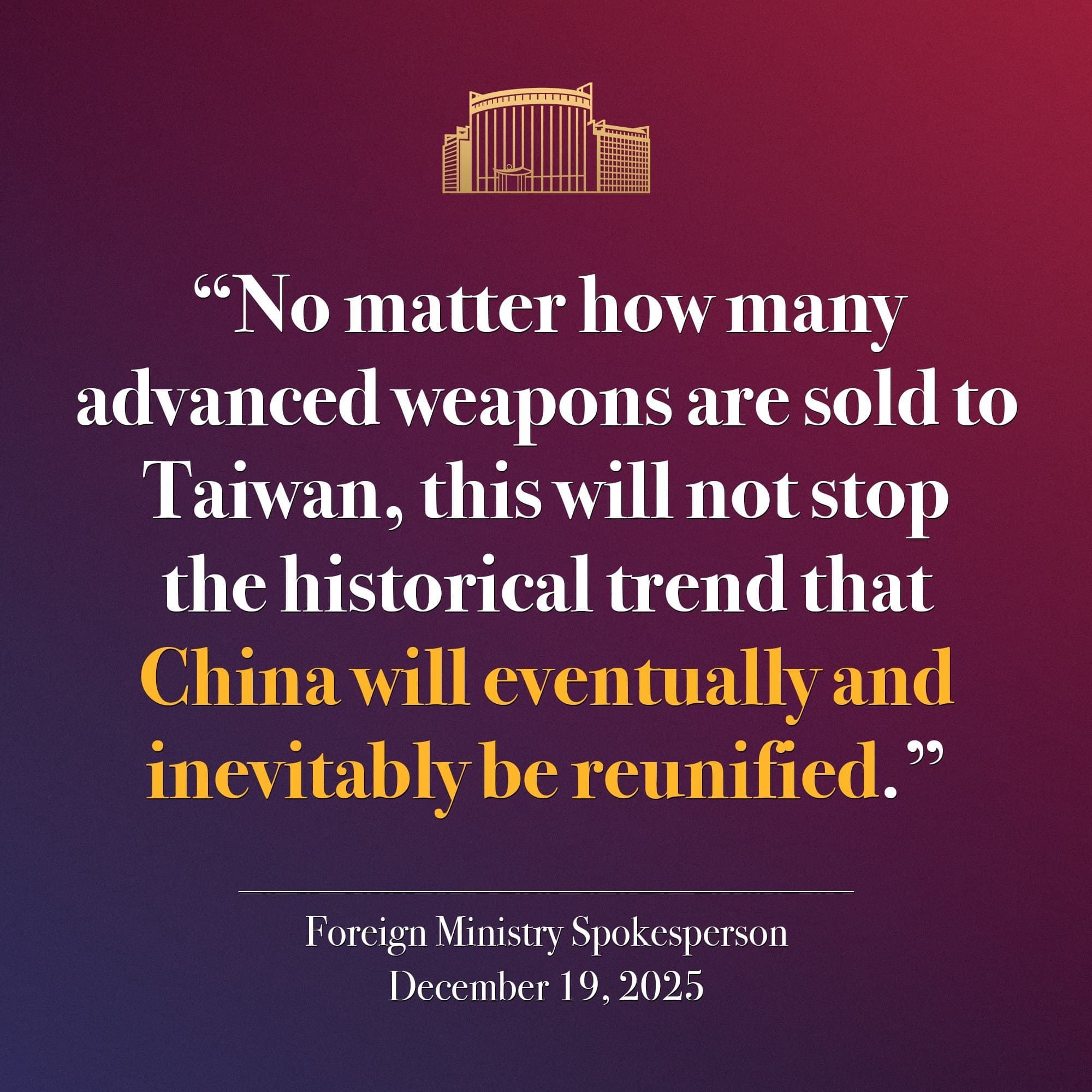
On December 20, 2025, the Chinese Foreign Ministry issued a strong condemnation of the United States" recent arms sales to Taiwan, asserting that these actions significantly interfere in China"s internal affairs and undermine its sovereignty, security, and territorial integrity. The statement was made public via the ministry"s official account on the social media platform X, formerly known as Twitter.
Key Details
The Chinese government expressed that the U.S. arms sales to Taiwan are not merely a bilateral issue but a matter that disrupts peace and stability in the Taiwan Strait. The ministry"s statement highlighted that such sales send a "seriously wrong message" to forces advocating for Taiwan"s independence, which China views as a significant threat to its national unity.
In its statement, the Chinese Foreign Ministry emphasized that "China strongly deplores and firmly opposes" the U.S. actions, asserting that no individual or force should underestimate the determination and capability of the Chinese government and its people to protect national sovereignty and territorial integrity. This assertion underscores China"s commitment to its territorial claims over Taiwan, which it considers a breakaway province.
Furthermore, the ministry pointed out that the real threat to peace and stability in the Taiwan Strait arises from the "separatist activities" of the current Taiwanese authorities, specifically referencing Lai Ching-te, who is the Vice President of Taiwan and a prominent advocate for Taiwan"s independence. The Chinese government accused external forces, particularly the United States, of exacerbating tensions in the region by providing military assistance to Taiwan under the guise of responding to threats.
China"s statement warned that such assistance would only serve to embolden the "Taiwan independence" separatists, placing the people of Taiwan in a precarious situation described as a "powder keg." The ministry cautioned that these developments could escalate tensions in the Taiwan Strait, increasing the likelihood of conflict and confrontation between China and the United States.
Background
The Taiwan Strait has long been a focal point of geopolitical tension between China and the United States. Following the Chinese Civil War, which concluded in 1949, Taiwan has operated as a separate entity, although China has consistently maintained its claim over the island. The U.S. has historically supported Taiwan through arms sales and political backing, particularly in the face of increasing military assertiveness from China.
In recent years, U.S.-Taiwan relations have strengthened, with the U.S. providing advanced military equipment to Taiwan as part of its commitment to assist in the island"s self-defense capabilities. This support has been met with strong opposition from China, which views such actions as provocations that threaten its sovereignty.
What"s Next
The ongoing tensions in the Taiwan Strait are likely to escalate as both the U.S. and China continue to assert their positions. The Chinese government’s firm stance against U.S. arms sales to Taiwan suggests that it may take further diplomatic or military measures to counter what it perceives as external interference in its internal affairs. As previously reported, the geopolitical landscape in the region remains volatile, with potential implications for U.S.-China relations and broader regional stability.
For more insights on related developments, see our recent developments in international relations.
![[Video] Car bomb detonates near Saed Allah Al Jaberi square in Aleppo](/_next/image?url=%2Fapi%2Fimage%2Fthumbnails%2Fthumbnail-1766234456017-ceckgn-thumbnail.jpg&w=3840&q=75)
![[Video] Russian-made Merlin-VR drone crashes in Balıkesir, Türkiye](/_next/image?url=%2Fapi%2Fimage%2Fthumbnails%2Fthumbnail-1766232643839-14lkma-thumbnail.jpg&w=3840&q=75)