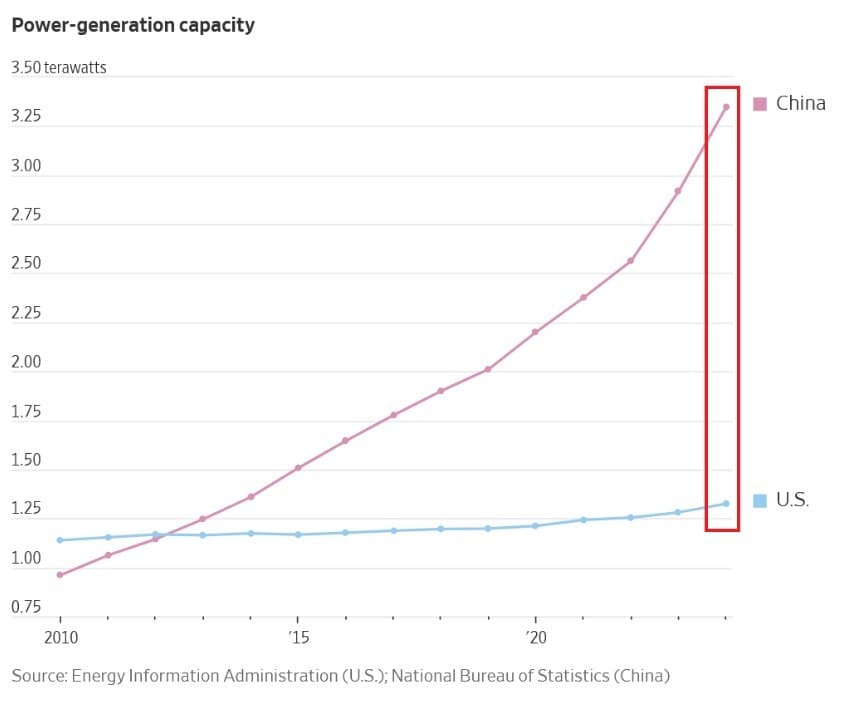
China Surges Ahead in Global Power Generation Capacity
As of December 2025, China has achieved a remarkable milestone in power generation, boasting a record capacity of 3.75 terawatts (TW). This figure represents a significant increase, having doubled over the past eight years. In stark contrast, the United States has a power generation capacity of approximately 1.30 terawatts, which is nearly three times less than that of China. This disparity highlights China"s dominance in the global energy sector and raises concerns about the United States" competitive position.
Key Details
China"s current power generation capacity of 3.75 terawatts is a testament to its rapid industrial growth and investment in energy infrastructure. Over the last eight years, this capacity has doubled, indicating a robust expansion in energy production capabilities. The United States, with its capacity of around 1.30 terawatts, faces a significant challenge in keeping pace with China"s advancements.
In terms of nuclear energy, China is leading the world with 34 nuclear reactors currently under construction. This number surpasses the combined total of the next nine countries, showcasing China"s aggressive approach to expanding its nuclear energy portfolio. Additionally, nearly 200 other nuclear reactors are either planned or proposed in China, further solidifying its position as a global leader in nuclear energy development.
Conversely, the United States is lagging behind in nuclear energy development, with no large commercial nuclear reactors currently under construction. This lack of progress raises alarms among industry experts and leaders, including prominent figures like Elon Musk, who has described the situation as a "major competitive disadvantage" for the U.S. in the global energy landscape.
Background
The significant gap in power generation capacity between China and the United States can be attributed to various factors, including differences in energy policy, investment in infrastructure, and public perception of nuclear energy. China has prioritized energy production as a key component of its economic strategy, investing heavily in both renewable and nuclear energy sources. This focus has allowed China to rapidly increase its energy output and meet the demands of its growing population and industrial sector.
In contrast, the United States has faced challenges in expanding its nuclear energy capabilities, including regulatory hurdles, public opposition to nuclear power, and a shift towards renewable energy sources. The combination of these factors has resulted in a stagnation of large-scale nuclear projects, leaving the U.S. vulnerable to energy supply challenges in the future.
What"s Next
The implications of China"s lead in power generation capacity are significant for the global energy market and international relations. As China continues to expand its energy infrastructure, it may gain increased leverage in geopolitical negotiations and trade agreements. The United States must take immediate action to bolster its energy production capabilities, particularly in the nuclear sector, to remain competitive on the world stage.
In light of these developments, it is crucial for U.S. policymakers and industry leaders to reassess their strategies and invest in energy technologies that will secure the nation"s energy future. The urgency of this situation is underscored by the potential consequences of falling behind in the global energy race.
For further insights on related topics, see our coverage on recent developments in international politics and energy policy.



![[Video] Secretary of State Marco Rubio criticizes Cuba's government as incompetent](/_next/image?url=%2Fapi%2Fimage%2Fthumbnails%2Fthumbnail-1766179259312-jv93j-thumbnail.jpg&w=3840&q=75)