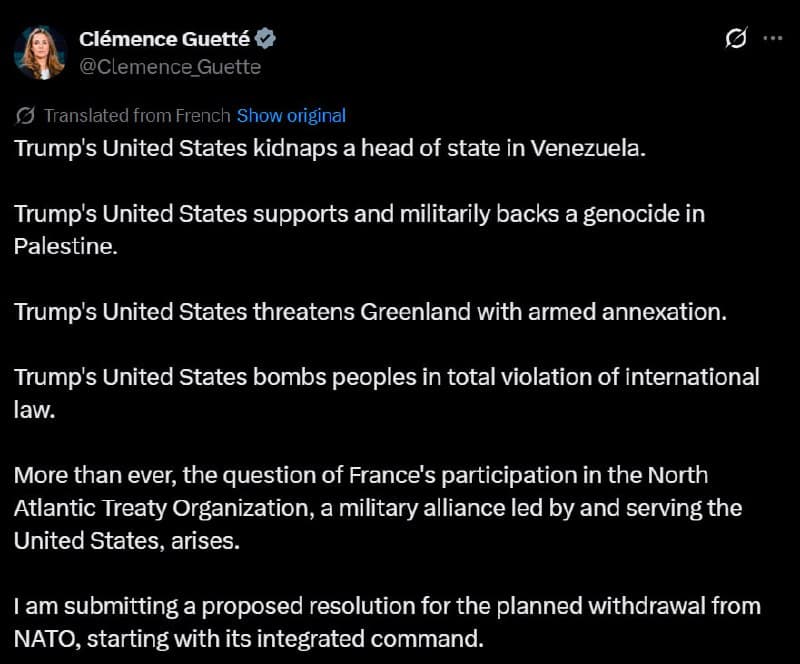
On January 9, 2026, Clémence Guetté, the First Vice-President of France"s National Assembly, announced her intention to submit a resolution aimed at planning France"s exit from NATO, particularly its integrated command structure. This declaration comes amid escalating criticisms of the United States" foreign policy actions under former President Donald Trump, which Guetté argues are in direct conflict with international law and humanitarian principles.
Key Details
Clémence Guetté, a prominent figure in French politics, has raised serious allegations against the United States, specifically during Donald Trump"s presidency. She accused the U.S. of engaging in actions that she describes as "kidnapping a head of state" in Venezuela, referring to the controversial U.S. involvement in Venezuelan politics, which has included support for opposition leaders against the government of Nicolás Maduro.
Furthermore, Guetté criticized the U.S. for its military support of Israel amidst the ongoing conflict in Palestine, which she characterized as a "genocide." This statement reflects the heightened tensions and humanitarian concerns surrounding the Israeli-Palestinian conflict, particularly in light of recent escalations in violence and civilian casualties.
In addition to her criticisms of U.S. foreign policy in Latin America and the Middle East, Guetté also pointed to the U.S. threats regarding Greenland, suggesting that the Trump administration had considered armed annexation of the territory. This claim references the broader geopolitical implications of U.S. interests in the Arctic region, which has become increasingly strategic due to climate change and resource accessibility.
Guetté"s resolution is not merely a reaction to these specific incidents but is also part of a larger discourse regarding France"s role in NATO, a military alliance primarily led by the United States. The question of France"s participation in NATO has gained traction, particularly among leftist and anti-imperialist factions within French politics, who argue that NATO"s alignment with U.S. policies undermines France"s sovereignty and ethical stance on international issues.
Background
The North Atlantic Treaty Organization (NATO) was established in 1949 as a collective defense alliance among its member states, which include the United States, Canada, and several European nations. The alliance has been a cornerstone of Western military strategy during the Cold War and beyond. However, recent geopolitical developments and military interventions have led to increased scrutiny of NATO"s role and the influence of U.S. foreign policy on its operations.
Guetté"s call for a reevaluation of France"s involvement in NATO is reflective of a broader sentiment in Europe, where some leaders and political movements are advocating for greater independence from U.S. military influence. This sentiment has been particularly pronounced in light of recent conflicts and the perceived unilateral actions taken by the U.S. in various global hotspots.
What"s Next
As Guetté prepares to submit her resolution, the implications for France"s military and foreign policy could be significant. If the resolution gains traction, it may initiate a formal debate within the French government and among NATO allies regarding the future of France"s participation in the alliance. Such a move could also embolden other nations to reconsider their commitments to NATO, potentially leading to a shift in the balance of power within the alliance.
In conclusion, Clémence Guetté"s resolution represents a critical moment in French politics, as it challenges the status quo of NATO"s alignment with U.S. foreign policy. The discussions that follow may have lasting impacts on France"s military strategy and its role in international affairs, particularly in relation to humanitarian issues and international law.
For more details on Guetté"s proposal, see our recent developments regarding France"s potential withdrawal from NATO"s integrated command.

![[Video] Antifa breaches hotel doors in Minneapolis, begins destroying lobby](/_next/image?url=%2Fapi%2Fimage%2Fthumbnails%2Fthumbnail-1768016467294-f3vk3j-thumbnail.jpg&w=3840&q=75)

![[Video] Minneapolis Police Chief O’Hara attacked by anti-ICE rioters](/_next/image?url=%2Fapi%2Fimage%2Fthumbnails%2Fthumbnail-1768017695156-omhdfv-thumbnail.jpg&w=3840&q=75)
![[Video] Anti-ICE protesters bang on hotel windows in Minneapolis](/_next/image?url=%2Fapi%2Fimage%2Fthumbnails%2Fthumbnail-1768015918763-n5slzl-thumbnail.jpg&w=3840&q=75)