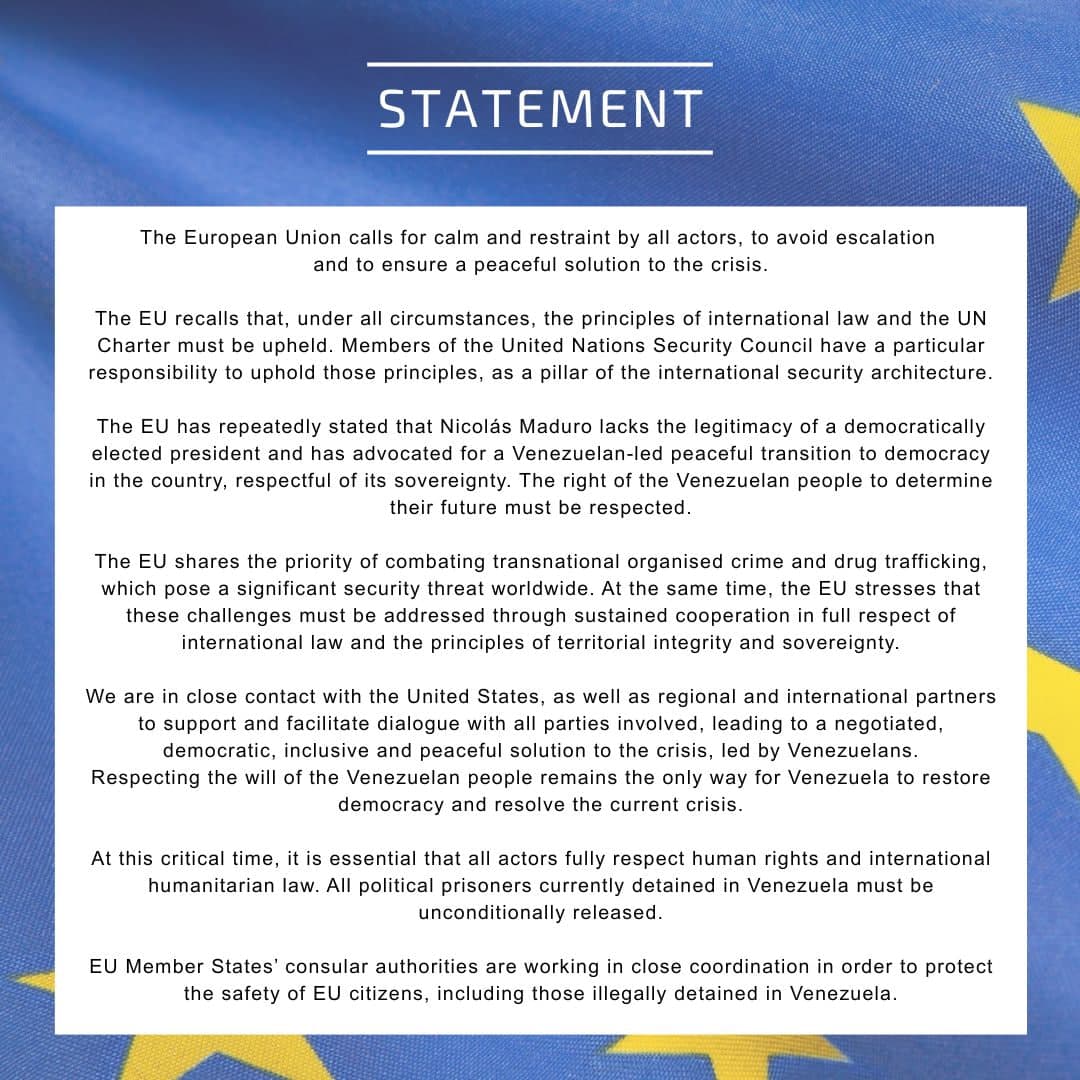
EU High Representative for Foreign Affairs, Kaja Kallas, has issued a statement supported by 26 EU Member States regarding the recent U.S. intervention in Venezuela. The statement reflects concerns about the effectiveness and influence of the European Union in global affairs, particularly in light of the ongoing crisis in Venezuela.
Key Details
Kaja Kallas, who serves as the EU High Representative for Foreign Affairs, has expressed her views on the current geopolitical situation in Venezuela following U.S. intervention. Her statement has garnered support from 26 EU Member States, indicating a significant level of consensus among European leaders regarding the matter.
In her statement, Kallas referenced comments made by Dries van Langenhove, who criticized the EU"s approach to foreign policy. Van Langenhove suggested that the EU is losing influence by attempting to exert soft power without the necessary backing to support its initiatives. He argued that the EU"s current strategy is ineffective and compared it to political parties that avoid debates to maintain public appeal when their power is perceived as weak.
Van Langenhove"s remarks included a call for a more assertive approach to national policy, advocating for the deportation of "hostile invaders," closing borders, and pursuing energy independence through the construction of nuclear reactors. He emphasized the need for growth over degrowth, nationalism over self-criticism, and a shift from legislative actions to innovation and development. Furthermore, he criticized the EU"s focus on social issues like LGBTQ rights, suggesting that resources should instead be directed toward strengthening military capabilities and exporting national power.
Background
The context of Kallas"s statement is rooted in the ongoing political and economic turmoil in Venezuela, which has been exacerbated by U.S. sanctions and interventions aimed at undermining the regime of Nicolás Maduro. The situation in Venezuela has drawn international attention, with various countries and organizations responding to the crisis in differing ways. The EU"s involvement has often centered around diplomatic efforts and humanitarian aid, but the effectiveness of these measures has been questioned in light of the current geopolitical climate.
Recent developments in Venezuela, such as the freezing of assets belonging to Nicolás Maduro and his associates by Switzerland, highlight the international community"s ongoing efforts to hold the Venezuelan government accountable for its actions. This situation underscores the complexities of foreign intervention and the challenges faced by the EU in asserting its influence in Latin America.
What"s Next
The implications of Kallas"s statement and the support from 26 EU Member States may lead to a reevaluation of the EU"s foreign policy strategies, particularly in relation to Venezuela. As the EU seeks to navigate its role in international affairs, the call for a more robust and coherent approach may prompt discussions among member states about the future direction of EU foreign policy.
As previously reported, the EU"s influence in global matters is increasingly scrutinized, and the effectiveness of its soft power initiatives will likely be a topic of ongoing debate. The situation in Venezuela remains fluid, and the EU"s response will be closely monitored by both supporters and critics of its foreign policy.
For more on the international implications of the Venezuelan crisis, see our previous reports on recent developments.