France to Vote NO on European Union–Mercosur Agreement, Says Macron
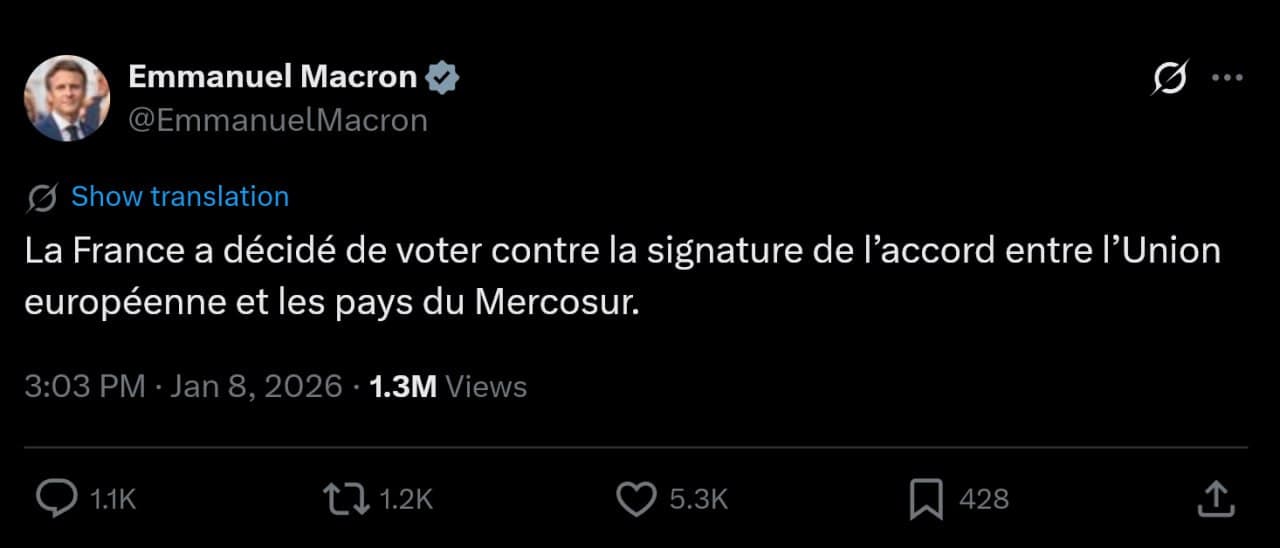
In a significant political move, French President Emmanuel Macron announced on January 8, 2026, that France will officially vote against the signing of the European Union (EU)–Mercosur agreement. This decision reflects France"s concerns over the implications of the trade deal for its agricultural sector and food sovereignty.
Key Details
Macron emphasized that while France supports international trade, the EU–Mercosur agreement, which has its roots in a 1999 mandate, is outdated and no longer suitable for current economic conditions. He noted that the anticipated economic benefit of the agreement would be minimal, projecting an increase of only 0.05% in the EU"s GDP by 2040, according to estimates from the European Commission.
Macron highlighted three key demands that France has successfully negotiated as part of its ongoing efforts to secure a fairer agreement for its farmers:
- Specific Safeguard Clause: France has secured an "emergency brake" mechanism that allows for the suspension of agricultural imports from Mercosur countries if there is a market destabilization in Europe. This clause can be activated with a mere 5% variation in prices and volumes of imported agricultural products and can be requested by any single EU Member State or representatives from agricultural sectors.
- Reciprocity Measures: France has obtained commitments for mirror measures that ensure imported products from Mercosur countries meet the same health, environmental, and animal welfare standards as those required of French producers. The European Commission has already begun implementing these measures for certain pesticide substances that have been banned in France.
- Strengthened Sanitary Controls: The agreement includes enhanced sanitary controls in Europe and veterinary and phytosanitary audits in Mercosur countries to ensure compliance with EU regulations. The establishment of a task force at the European Commission to oversee these controls is a step toward the comprehensive sanitary control framework that France has long advocated.
Despite these advancements, Macron stated that there remains a "unanimous political rejection" of the agreement within France, as evidenced by recent debates in the National Assembly and the Senate. He reiterated that France"s vote against the agreement reflects the need to protect its farmers and agricultural interests.
Macron also mentioned that the European Commission has made significant commitments during an agriculture meeting held on January 7, 2026, in Brussels. These include:
- An additional €45 billion in direct Common Agricultural Policy (CAP) aid available from 2028, supplementing the nearly €294 billion already secured for direct agricultural income support.
- A commitment that there will be no price increase for fertilizers linked to the EU"s carbon border tax.
Background
The EU–Mercosur agreement, which aims to establish a free trade zone between the EU and the South American trade bloc comprising Argentina, Brazil, Paraguay, and Uruguay, has been under negotiation for over two decades. The deal has faced criticism from various stakeholders, particularly in the agricultural sector, due to concerns about its potential impact on local farmers and food production standards.
What"s Next
Looking ahead, Macron affirmed his commitment to continue advocating for the full and concrete implementation of the commitments obtained from the European Commission. He emphasized that the signing of the agreement does not mark the end of the discussion, as France will persist in its efforts to protect its agricultural sector and ensure that trade policies align with national interests. The current priority for France at the European level is to accelerate an agenda focused on protection, competitiveness, and investment.
As the situation develops, the implications of France"s decision to vote against the EU–Mercosur agreement will likely reverberate through European trade discussions and influence future negotiations with other international partners.
![[Video] Tehran Mayor reports protesters attacked hospitals, banks, and mosques](/_next/image?url=%2Fapi%2Fimage%2Fthumbnails%2Fthumbnail-1767958840054-91un3e-thumbnail.jpg&w=3840&q=75)
![[Video] Massive nationwide anti-regime protests in Iran enter day 13](/_next/image?url=%2Fapi%2Fimage%2Fthumbnails%2Fthumbnail-1767941441154-n29zg-thumbnail.jpg&w=3840&q=75)
![[Video] U.S. forces seize oil tanker Olina in Caribbean Sea near Trinidad](/_next/image?url=%2Fapi%2Fimage%2Fthumbnails%2Fthumbnail-1767969051364-hp1e4k-thumbnail.jpg&w=3840&q=75)