Iran"s Ayatollah Khamenei Plans to Flee to Russia Amid Escalating Protests
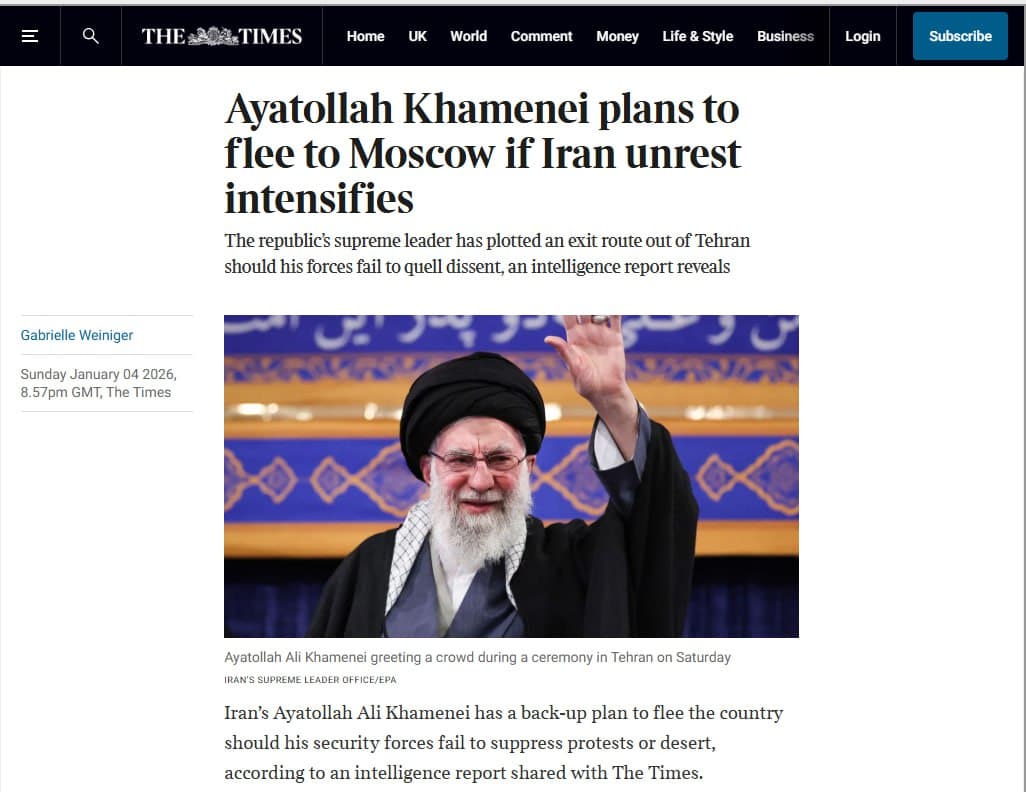
In a significant development reported by The Times, Ayatollah Ali Khamenei, the Supreme Leader of Iran, is reportedly preparing an escape plan to the Russian Federation should ongoing protests in Iran escalate into a full counter-revolution. This information comes from an intelligence report that outlines Khamenei"s contingency measures in the event that his security forces fail to suppress the unrest.
Key Details
Ayatollah Ali Khamenei, who is currently 86 years old, has devised a "plan B" that involves fleeing Tehran with a close circle of aides and family members. This group is expected to include up to 20 individuals, among them his son, Mojtaba Khamenei, who has been nominated as his potential heir apparent. The intelligence source cited in the report emphasized that this escape plan would be activated if the Iranian army and security forces, tasked with quelling the protests, begin to desert, defect, or fail to follow orders.
Beni Sabti, a former Israeli intelligence officer who fled Iran eight years after the Islamic Revolution, provided insight into Khamenei"s potential destination. He stated that Moscow is the only viable option for Khamenei, indicating the limited choices available to the Iranian leader should he decide to leave the country. This perspective underscores the geopolitical ties between Iran and Russia, particularly in times of crisis.
Background
The protests in Iran have been fueled by widespread discontent over various issues, including economic hardships, political repression, and social injustices. The Iranian regime has faced significant challenges in maintaining control, with many citizens openly expressing their dissatisfaction with the government. The situation has escalated to a point where Khamenei feels the need to prepare for a potential exodus, reflecting the severity of the unrest.
The Islamic Republic of Iran, established after the 1979 revolution, has a history of political turmoil and public dissent. Khamenei has been in power since 1989, and his leadership has been marked by strict adherence to Islamic principles and a strong opposition to Western influence. The current protests represent one of the most significant challenges to his authority in recent years.
What"s Next
The implications of Khamenei"s potential flight could be profound for Iran and the broader region. If he were to leave, it could lead to a power vacuum and further instability within the Iranian government. Additionally, such a move might embolden protestors and opposition groups, potentially leading to a more significant push for political change.
As the situation continues to develop, it remains to be seen how the Iranian government will respond to the ongoing protests and whether Khamenei"s contingency plan will come into play. The international community is closely monitoring the situation, as any significant changes in Iran could have far-reaching consequences for regional stability and global geopolitics.
For further context on international relations and recent developments, readers may refer to related coverage on the geopolitical landscape, including the U.S. stance on various global issues, such as the need for Greenland for national security and the situation in Venezuela.
For more information, see our previous reports on similar situations in other countries facing political unrest.
![[Video] Germany to accept responsibility for Ukraine's security, says Chancellor Merz](/_next/image?url=%2Fapi%2Fimage%2Fthumbnails%2Fthumbnail-1767732646788-32rvaa-thumbnail.jpg&w=3840&q=75)
![[Video] Macron: Russia has broken peace agreements in Moldova, Georgia, and Ukraine](/_next/image?url=%2Fapi%2Fimage%2Fthumbnails%2Fthumbnail-1767728468887-d79e9f-thumbnail.jpg&w=3840&q=75)

![[Video] Venezuelan interim President Delcy Rodriguez responds to US threats](/_next/image?url=%2Fapi%2Fimage%2Fthumbnails%2Fthumbnail-1767734488626-330x2s-thumbnail.jpg&w=3840&q=75)