Israeli Foreign Minister Condemns Syrian Regime"s Attacks on Kurds in Aleppo
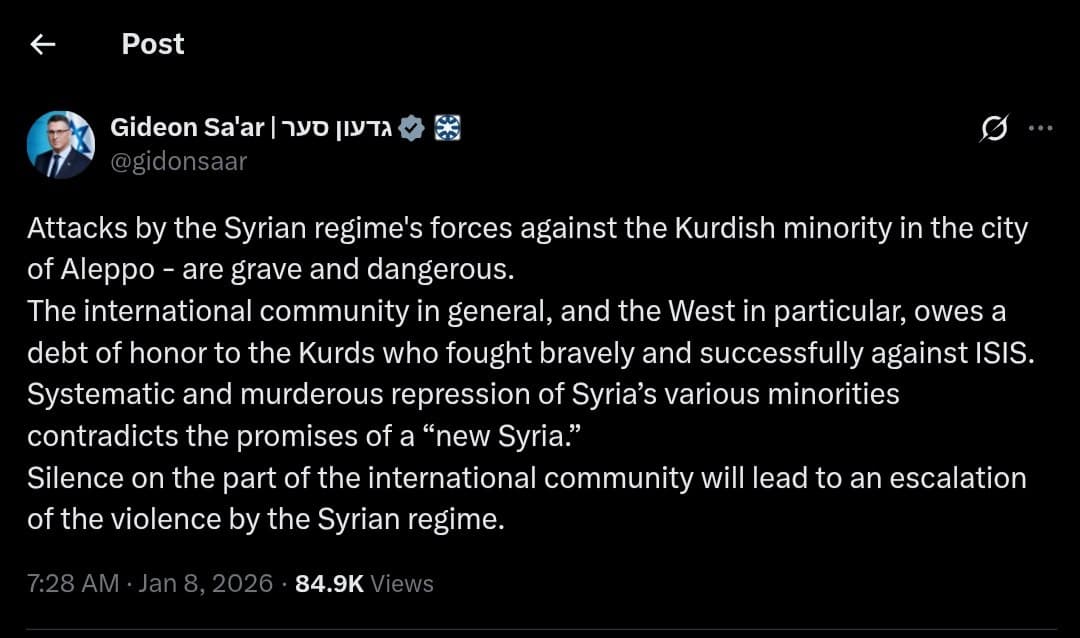
On January 8, 2026, Israeli Foreign Minister Gideon Sa"ar issued a strong condemnation of the Syrian regime"s military actions against the Kurdish minority in the city of Aleppo. Sa"ar characterized these attacks as "grave and dangerous," emphasizing the need for the international community, particularly Western nations, to respond decisively to the ongoing violence.
Key Details
In his statement, Sa"ar highlighted the historical context of the Kurdish struggle, noting that the Kurdish forces have played a crucial role in the fight against the Islamic State of Iraq and Syria (ISIS). He stated that the international community owes a "debt of honor" to the Kurds for their bravery and success in combating this extremist group. This acknowledgment reflects the significant contributions of Kurdish fighters in various operations that have dismantled ISIS strongholds in the region.
Sa"ar"s remarks come amid reports of systematic repression faced by various minority groups in Syria, including the Kurds. He pointed out that such actions by the Syrian regime contradict the promises made for a "new Syria," which was expected to embrace inclusivity and respect for human rights. The ongoing violence against minorities, particularly in Aleppo, raises concerns about the future of ethnic and religious diversity in the country.
Furthermore, Sa"ar warned that continued silence from the international community regarding these attacks could lead to an escalation of violence perpetrated by the Syrian regime. His comments underscore a growing urgency for global leaders to take a stand against human rights violations and to support vulnerable populations in conflict zones.
Background
The Kurdish population in Syria has faced significant challenges throughout the ongoing civil war, which began in 2011. The conflict has resulted in a complex landscape where various factions, including the Syrian government, Kurdish forces, and extremist groups like ISIS, have vied for control. The Kurds have established a semi-autonomous region in northern Syria, known as Rojava, which has been a focal point for both local governance and resistance against ISIS.
Despite their contributions to the fight against ISIS, the Kurds have often found themselves marginalized in the broader political landscape of Syria. The Syrian government"s recent military operations in Aleppo are seen as part of a broader strategy to reassert control over areas with significant Kurdish populations, further exacerbating tensions in the region.
What"s Next
As the situation in Syria continues to evolve, the international community faces critical decisions regarding its engagement with the Syrian regime and support for minority groups. Sa"ar"s call for action may resonate with other nations that have previously expressed concern over human rights abuses in Syria. The potential for increased diplomatic pressure or sanctions against the Syrian government could emerge as a response to the ongoing violence.
In related developments, the geopolitical landscape remains tense, with various nations reassessing their positions on Syria and its allies. As previously reported, U.S. foreign policy has seen shifts, including a withdrawal from numerous international organizations, which may impact collective responses to crises like the one unfolding in Aleppo. The implications of these international dynamics will be crucial in shaping the future of minority rights and stability in Syria.
For more on the implications of U.S. foreign policy, see our article on recent developments regarding the U.S. withdrawal from international organizations.
![[Video] Trump warns Iran against harming unarmed protesters](/_next/image?url=%2Fapi%2Fimage%2Fthumbnails%2Fthumbnail-1767933044934-1pxs1s-thumbnail.jpg&w=3840&q=75)
![[Video] Trump comments on Iran protests, reports of deaths from stampedes](/_next/image?url=%2Fapi%2Fimage%2Fthumbnails%2Fthumbnail-1767932450313-er2z2b-thumbnail.jpg&w=3840&q=75)
![[Video] Trump warns Iran could collapse and threatens strong response to violence](/_next/image?url=%2Fapi%2Fimage%2Fthumbnails%2Fthumbnail-1767931844652-3d9f4s-thumbnail.jpg&w=3840&q=75)
![[Video] Trump announces U.S. will begin land strikes on cartels in Mexico](/_next/image?url=%2Fapi%2Fimage%2Fthumbnails%2Fthumbnail-1767927774295-5ttmo-thumbnail.jpg&w=3840&q=75)