Report Discusses China"s Options for Taiwan Unification, Notes Lack of Invasion Ships
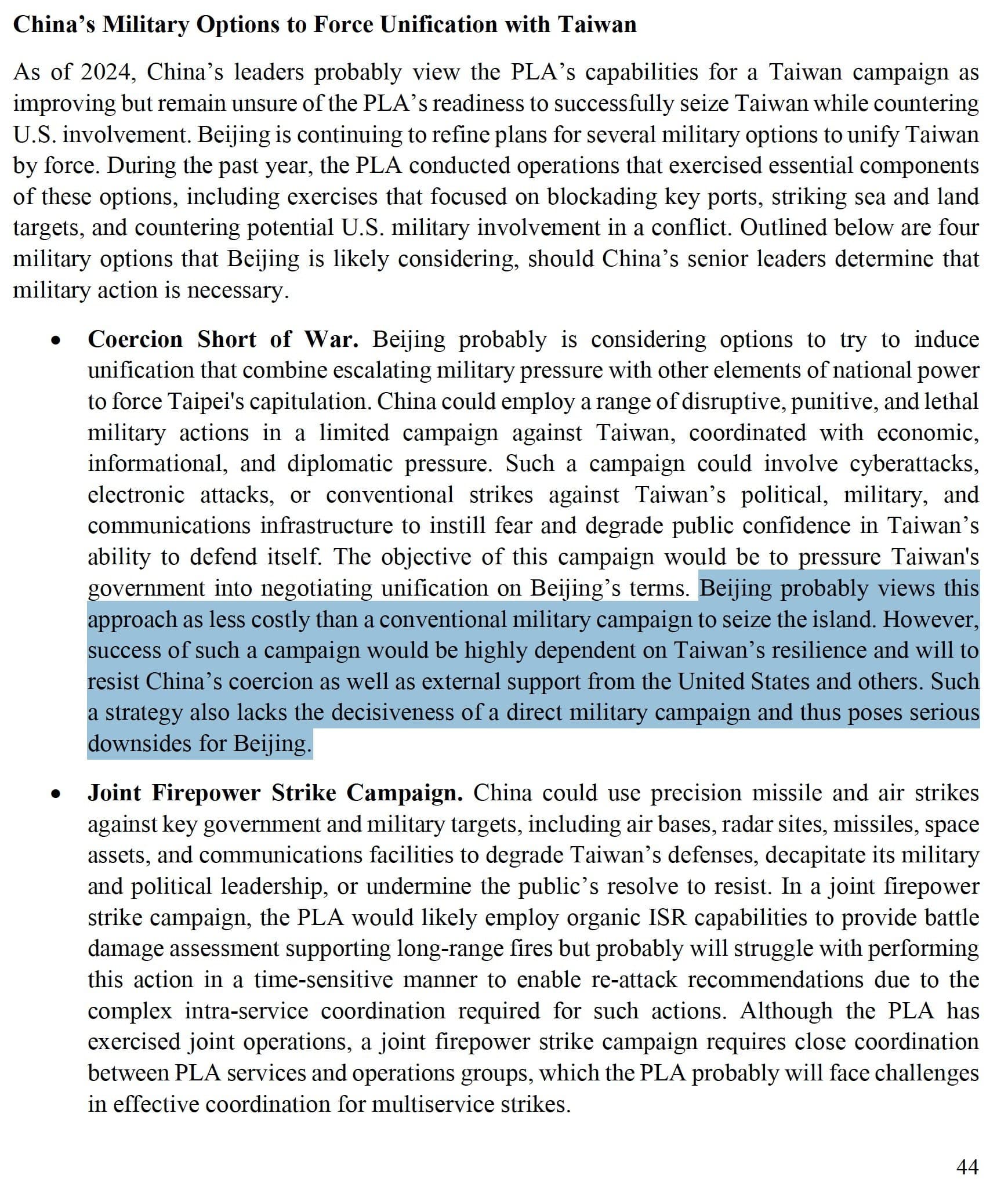
As tensions continue to rise between China and Taiwan, a recent report has shed light on the various strategies China may employ to achieve unification with Taiwan. The report emphasizes that while an invasion poses significant risks, it remains the only guaranteed method for compelling Taiwan to surrender. Alternatives such as a blockade or missile bombardment, although seemingly less risky, rely on Taiwan"s willingness to capitulate, which the report suggests is uncertain.
Key Details
The report highlights that the People"s Liberation Army (PLA) of China has not been focusing on building the necessary landing ships that would facilitate a full-scale invasion of Taiwan. Despite this, the PLA has been training with civilian roll-on/roll-off (Ro/Ro) vessels, which could be repurposed for military use. The report indicates that these civilian vessels may serve as preliminary components of a broader invasion strategy, with the hope that they could intimidate Taiwan into submission before a direct assault is launched.
Interestingly, the report does not mention China"s newly developed Shuiqiao-class landing ships, also known as Landing Platform Units (LPUs), which were publicly revealed at the beginning of 2025. This omission is notable, especially considering the significance of these vessels in enhancing China"s amphibious capabilities. The Shuiqiao-class ships could play a crucial role in any future military operations aimed at Taiwan, yet their absence from the report raises questions about the current state of China"s military preparedness.
Background
The ongoing tensions between China and Taiwan have historical roots, with China considering Taiwan a breakaway province that must eventually be reunified with the mainland. The situation has escalated in recent years, with increased military maneuvers by China in the Taiwan Strait and growing international concern over the potential for conflict. The United States has expressed support for Taiwan, complicating the geopolitical landscape further.
In recent developments, the international community has been closely monitoring China"s military activities, particularly in light of previous reports that have assessed the PLA"s capabilities and intentions regarding Taiwan. As previously reported, the implications of a potential conflict could extend beyond the region, affecting global trade and security dynamics.
What"s Next
The report"s findings suggest that while China may be exploring various options for unification, the lack of adequate landing ships could hinder its ability to execute a successful invasion. This raises important questions about China"s military strategy and its long-term objectives regarding Taiwan. As the situation evolves, analysts will be watching closely for any shifts in China"s military posture or additional developments in its naval capabilities.
In conclusion, the complexities surrounding China"s approach to Taiwan remain a focal point of international concern. The potential for conflict continues to loom, and the global community must remain vigilant in monitoring these developments. For further insights into related geopolitical issues, see our recent developments on international relations.
![[Video] Trump says Russia will help with Ukraine's reconstruction efforts](/_next/image?url=%2Fapi%2Fimage%2Fthumbnails%2Fthumbnail-1766961644481-tywlf-thumbnail.jpg&w=3840&q=75)
![[Video] Zelensky announces 20-point peace plan, 90% agreed with US security guarantees](/_next/image?url=%2Fapi%2Fimage%2Fthumbnails%2Fthumbnail-1766959850389-xy8ag9-thumbnail.jpg&w=3840&q=75)

![[Video] Trump claims U.S. conducted land strike in Venezuela on December 24](/_next/image?url=%2Fapi%2Fimage%2Fthumbnails%2Fthumbnail-1766964044150-5248ot-thumbnail.jpg&w=3840&q=75)

![[Video] Trump: 91% of Ukrainians want war to end, urges approval for plan](/_next/image?url=%2Fapi%2Fimage%2Fthumbnails%2Fthumbnail-1766960442618-1rmg3-thumbnail.jpg&w=3840&q=75)