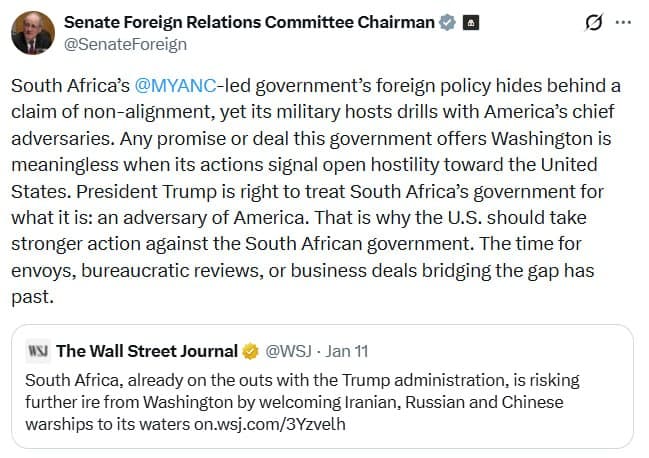
Senate Foreign Relations Committee Chairman Jim Risch Labels South Africa an Adversary of the United States
On January 13, 2026, Jim Risch, the Chairman of the Senate Foreign Relations Committee, publicly criticized the South African government, led by the African National Congress (ANC), for its foreign policy stance. In a post on the social media platform X, Risch asserted that South Africa"s claims of non-alignment in international relations are undermined by its military cooperation with nations that are considered adversaries of the United States, specifically naming Russia and China. Risch"s comments come amid heightened tensions between the U.S. and these nations, particularly in the context of military exercises.
Key Details
Risch"s statement emphasized that the ANC-led government"s foreign policy is deceptive, suggesting that any agreements or promises made to the United States are rendered meaningless by its actions, which Risch interprets as openly hostile. He stated, “Any promise or deal this government offers Washington is meaningless when its actions signal open hostility toward the United States.” This assertion reflects a growing concern among U.S. lawmakers regarding South Africa"s military engagements with countries that have strained relations with the U.S.
Risch further remarked that former President Donald Trump was correct in his assessment of the South African government as an adversary. He indicated that the U.S. should adopt a more aggressive stance towards South Africa, suggesting that diplomatic efforts such as sending envoys, conducting bureaucratic reviews, or pursuing business deals are no longer viable options. Risch"s call for stronger action signals a shift towards a more confrontational approach in U.S.-South Africa relations.
Background
The African National Congress (ANC) has been the ruling party in South Africa since the end of apartheid in 1994. The party"s foreign policy has often been characterized by a stance of non-alignment, which aims to maintain independence from the influence of major global powers. However, recent military exercises conducted by South Africa in collaboration with China and Russia have raised eyebrows in Washington, leading to concerns about the implications for U.S. interests in the region.
Historically, the U.S. has maintained a complex relationship with South Africa, balancing support for democratic governance and human rights with strategic interests in the region. The recent military drills, which included naval exercises, have been perceived as a signal of South Africa"s shifting allegiances and potential alignment with nations that oppose U.S. policies.
What"s Next
Risch"s statements may pave the way for a reevaluation of U.S. foreign policy towards South Africa, potentially leading to increased scrutiny of bilateral relations. As tensions escalate, the U.S. government may consider implementing sanctions or other measures aimed at curtailing South Africa"s military cooperation with adversarial nations. The implications of this shift could affect not only diplomatic relations but also economic ties between the two countries.
In light of these developments, it is crucial to monitor how the U.S. government responds to Risch"s call for stronger action. The situation remains fluid, and further developments may arise as the U.S. seeks to navigate its interests in a rapidly changing geopolitical landscape.
For related coverage on international relations and U.S. foreign policy, see our articles on recent developments and previous reports regarding U.S. interactions with other nations.
![[Video] Iran seizes large shipment of spying equipment, including Starlink terminals](/_next/image?url=%2Fapi%2Fimage%2Fthumbnails%2Fthumbnail-1768329065768-8e54-thumbnail.jpg&w=3840&q=75)

![[Video] Trump tours Ford Dearborn Truck Plant in Michigan, highlights U.S. manufacturing](/_next/image?url=%2Fapi%2Fimage%2Fthumbnails%2Fthumbnail-1768329041868-iievw-thumbnail.jpg&w=3840&q=75)