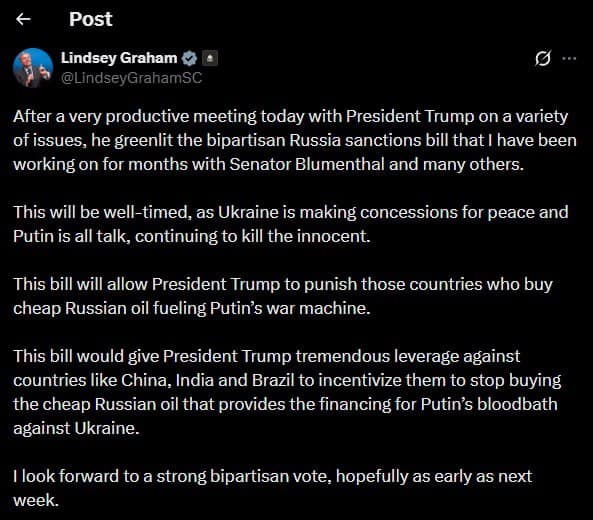
Senator Lindsey Graham announces bipartisan Russia sanctions bill
By Rachel Green
Date: January 8, 2026
In a significant development in U.S. foreign policy, U.S. Senator Lindsey Graham has confirmed that President Donald Trump has approved a bipartisan sanctions bill aimed at curbing the flow of Russian oil to countries that support the ongoing conflict in Ukraine. This announcement was made public on Thursday, January 8, 2026, and marks a collaborative effort between Graham and fellow Senator Richard Blumenthal, along with other lawmakers, to address the financial underpinnings of Russia"s military actions.
Key Details
The sanctions bill, which has been in development for several months, is designed to empower President Trump to impose penalties on nations that continue to purchase inexpensive Russian oil. Senator Graham emphasized that this legislation is crucial for undermining the financial resources available to Russian President Vladimir Putin, which are being utilized to sustain military operations in Ukraine. The bill aims to provide the U.S. with substantial leverage against key countries such as China, India, and Brazil, which have been identified as significant buyers of Russian oil.
Graham stated, "This bill will allow President Trump to punish those countries who buy cheap Russian oil fueling Putin’s war machine." He expressed optimism about the bill"s prospects, indicating that he anticipates a strong bipartisan vote in Congress, potentially as early as next week. The bipartisan nature of the bill reflects a growing consensus among U.S. lawmakers regarding the need to take decisive action against nations that contribute to the financing of the conflict in Ukraine through their oil purchases.
Background
The ongoing war in Ukraine, which began in February 2022, has drawn international condemnation and led to various sanctions against Russia. However, the continued purchase of Russian oil by several countries has raised concerns about the effectiveness of these sanctions. The U.S. and its allies have been seeking ways to further isolate Russia economically and limit its ability to fund military operations. The bipartisan sanctions bill represents a strategic effort to address this issue by targeting the financial transactions that support the Kremlin"s military agenda.
Senator Blumenthal, who has collaborated closely with Graham on this initiative, has also voiced support for the bill, highlighting the need for a united front against Russian aggression. The collaboration between Graham and Blumenthal underscores the importance of bipartisan efforts in addressing complex foreign policy challenges.
What"s Next
As the bill moves forward, it is expected to undergo discussions and revisions in Congress. The anticipated bipartisan support suggests that lawmakers from both parties recognize the urgency of the situation and the need for a coordinated response to Russian aggression. If passed, the sanctions could significantly impact the global oil market and influence the purchasing decisions of countries currently reliant on Russian oil.
In related developments, the political landscape in the U.S. remains dynamic, with various issues being addressed in Congress. For instance, recent developments regarding the House Oversight Committee"s decision to subpoena Les Wexner in the Epstein probe highlight the ongoing scrutiny of political figures and their connections. Additionally, Rep. Robin Kelly"s plans to file articles of impeachment against South Dakota Governor Kristi Noem further illustrate the contentious political climate.
As the situation develops, the implications of the sanctions bill and the U.S. response to Russia"s actions will continue to be closely monitored by both domestic and international observers.
![[Video] Adam Schiff says Renee Nicole Good had no involvement in protest](/_next/image?url=%2Fapi%2Fimage%2Fthumbnails%2Fthumbnail-1767930042918-mkxkna-thumbnail.jpg&w=3840&q=75)
![[Video] Oregon Governor Kotek criticizes president for endorsing division](/_next/image?url=%2Fapi%2Fimage%2Fthumbnails%2Fthumbnail-1767927794180-0hdcjj-thumbnail.jpg&w=3840&q=75)
![[Video] Trump warns Iran against harming unarmed protesters](/_next/image?url=%2Fapi%2Fimage%2Fthumbnails%2Fthumbnail-1767933044934-1pxs1s-thumbnail.jpg&w=3840&q=75)
![[Video] Trump comments on Iran protests, reports of deaths from stampedes](/_next/image?url=%2Fapi%2Fimage%2Fthumbnails%2Fthumbnail-1767932450313-er2z2b-thumbnail.jpg&w=3840&q=75)