Spain Reaffirms Support for Moroccan Autonomy Plan for Western Sahara Following UN Resolution
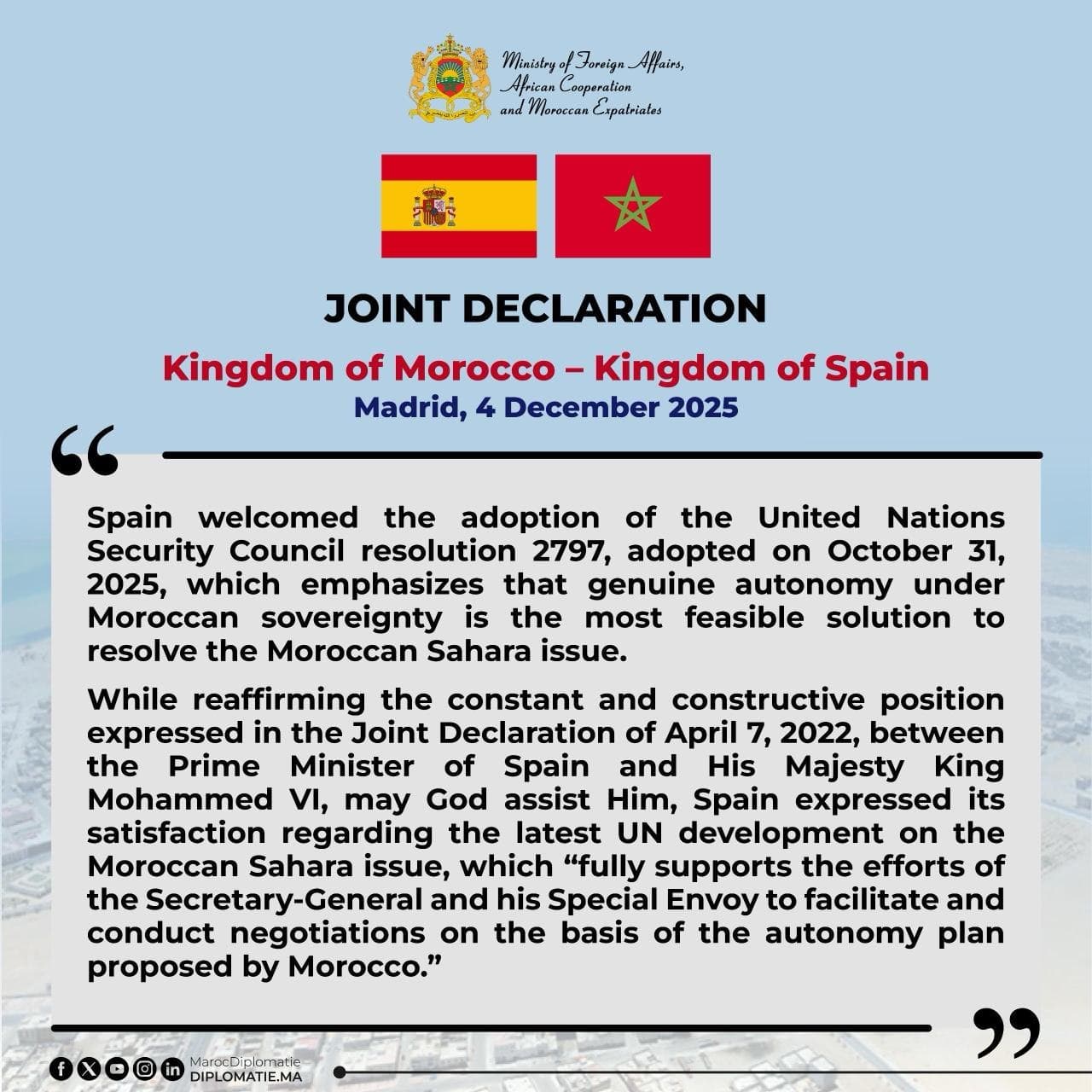
In a significant diplomatic move, Spain has reiterated its endorsement of Morocco"s autonomy plan for Western Sahara, coinciding with the adoption of UN Security Council Resolution 2797 on October 31, 2025. This resolution, part of ongoing international efforts to address the long-standing territorial dispute, recognizes Morocco"s 2007 proposal as a "credible and viable" framework for resolving the issue under Moroccan sovereignty.
Key Details
The announcement came during the 13th Spain-Morocco High-Level Meeting, where officials from both nations gathered to discuss bilateral relations and regional stability. Spain"s support for Morocco"s autonomy initiative aligns with its established position since 2022, which emphasizes the importance of negotiations aimed at achieving a "just, lasting, and mutually acceptable" solution to the Western Sahara conflict.
UN Security Council Resolution 2797 specifically endorses Morocco"s autonomy plan, which has been a focal point of international discussions regarding the status of Western Sahara, a territory that has been contested since Spain withdrew its colonial administration in 1975. The resolution reflects a growing consensus among various member states on the need for a negotiated settlement that respects Morocco"s territorial integrity while addressing the aspirations of the Sahrawi people.
Spain"s reaffirmation of support is particularly noteworthy given its historical ties to Western Sahara and its role as a former colonial power in the region. The Spanish government has been vocal about its commitment to facilitating dialogue between Morocco and the Sahrawi people, represented by the Polisario Front, which seeks independence for Western Sahara.
Background
The Western Sahara conflict has persisted for decades, with roots tracing back to the decolonization process in the mid-20th century. Following Spain"s departure, Morocco annexed the territory, leading to a protracted struggle involving military confrontations and diplomatic negotiations. The United Nations has been involved in mediating the dispute, with various resolutions aimed at fostering dialogue and promoting peace in the region.
Morocco"s autonomy plan, proposed in 2007, suggests granting the region a degree of self-governance while maintaining Moroccan sovereignty. This proposal has been met with mixed reactions; while some countries have supported it, others, including Algeria, have backed the Polisario Front"s call for a referendum on self-determination for the Sahrawi people.
What"s Next
Spain"s endorsement of Morocco"s autonomy plan is expected to influence future negotiations and discussions within the UN framework. As the international community continues to seek a resolution to the Western Sahara dispute, Spain"s position may encourage other nations to align with Morocco"s proposal, potentially reshaping the dynamics of the conflict.
Furthermore, this development could have broader implications for Spain-Morocco relations, particularly in areas such as trade, security cooperation, and migration management. The two nations have historically collaborated on various fronts, and reaffirming support for Morocco"s stance may strengthen their partnership in addressing regional challenges.
As previously reported, similar situations in international diplomacy often hinge on the alignment of key players, and Spain"s recent actions may serve as a catalyst for renewed efforts toward a peaceful resolution in Western Sahara.
For more on international relations and recent developments, see our coverage on Qatar Prime Minister Al Thani"s statements regarding Israel and armed clashes between the Pakistani Army and Afghan Taliban.


