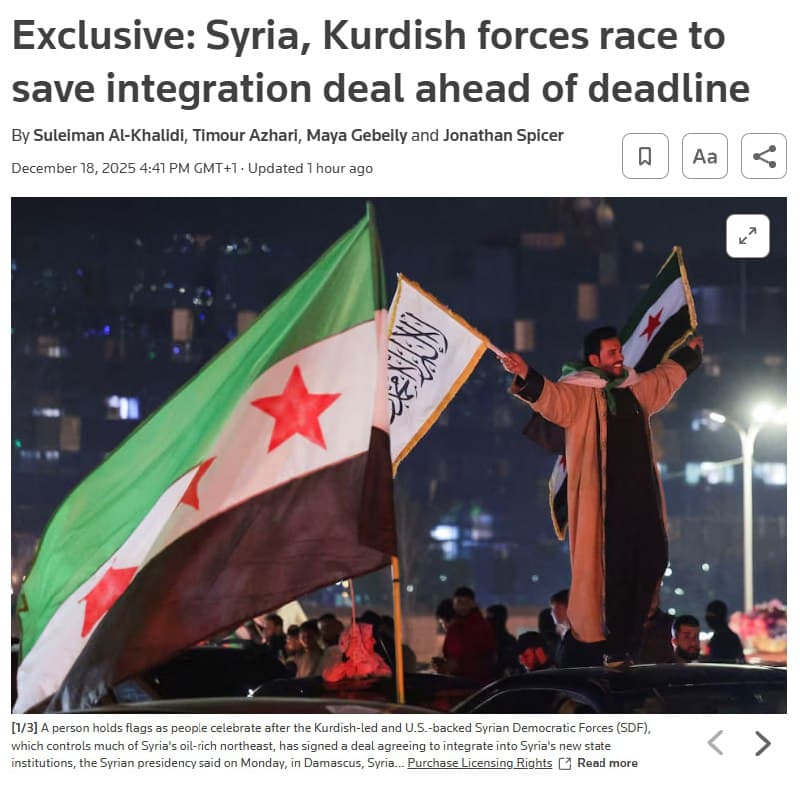
Syrian, Kurdish, and U.S. officials are actively working to revive stalled negotiations regarding the integration of the Syrian Democratic Forces (SDF) into Syria"s state institutions before the end of the year. This effort is reported by Reuters and highlights the ongoing complexities of the Syrian conflict, which has seen various factions vying for power and control since the civil war began in 2011.
Key Details
The Syrian Democratic Forces, a coalition predominantly composed of Kurdish fighters, currently has approximately 50,000 members. These forces have played a crucial role in the fight against ISIS in Syria, receiving support from the United States and other allies. In the latest round of discussions, the government of Damascus has proposed a significant reorganization of the SDF. This plan involves restructuring the SDF into three distinct divisions. In exchange for this reorganization, the Syrian government is seeking to reduce the command autonomy of the SDF and allow access for Syrian army units to operate alongside them.
Despite the intensification of negotiations in recent weeks, officials involved in the talks have expressed skepticism about the likelihood of achieving a full breakthrough. The prevailing sentiment is that any agreement reached in the near term is more likely to be a temporary measure aimed at extending dialogue and preventing further instability, rather than a comprehensive solution that fully integrates the SDF into the Syrian state framework.
Background
The Syrian Democratic Forces emerged as a key player in the Syrian conflict, particularly noted for their effectiveness in combating ISIS. Their relationship with the U.S. has been characterized by military support and strategic cooperation, which has complicated the dynamics with the Syrian government and its allies. The SDF"s autonomy and control over regions in northeastern Syria have been points of contention, particularly as the Syrian government seeks to reassert its authority over the entire country following years of civil war.
The proposal from Damascus reflects a broader strategy to consolidate power and reintegrate various armed groups into the national framework, a process that has been fraught with challenges. The complexities of the Syrian conflict, including the involvement of international actors and the diverse interests of local factions, make any potential agreement difficult to navigate.
What"s Next
As the year draws to a close, the focus on these negotiations will likely continue, with both Syrian and Kurdish officials, along with their U.S. counterparts, seeking to find common ground. However, the expectation remains that significant hurdles will need to be overcome before any lasting resolution can be achieved. The ongoing discussions are critical not only for the future of the SDF but also for the broader stability of Syria, which has been marked by ongoing violence and humanitarian crises.
In light of these developments, observers are keenly watching the situation, as any agreements reached could have far-reaching implications for the region"s security and governance. For further context on international relations and security issues, see our related coverage on the importance of regional stability.
![[Video] Joint Task Force Southern Spear conducts strikes, kills five narco-terrorists](/_next/image?url=%2Fapi%2Fimage%2Fthumbnails%2Fthumbnail-1766112046651-a9lgp-thumbnail.jpg&w=3840&q=75)

![[Video] FBI links MIT Nuclear Scientist murder to Brown University shooter in Lisbon](/_next/image?url=%2Fapi%2Fimage%2Fthumbnails%2Fthumbnail-1766114460322-f0219la-thumbnail.jpg&w=3840&q=75)
![[Video] Providence Police Chief: Claudio Valente acted alone, no antisemitism involved](/_next/image?url=%2Fapi%2Fimage%2Fthumbnails%2Fthumbnail-1766113851389-coopcb-thumbnail.jpg&w=3840&q=75)
![[Video] Brown University suspect identified as Claudio Manuel Neves-Valente, 48](/_next/image?url=%2Fapi%2Fimage%2Fthumbnails%2Fthumbnail-1766112697009-8f53bc-thumbnail.jpg&w=3840&q=75)