Trump Administration Expands Military Presence in El Salvador with New Aircraft
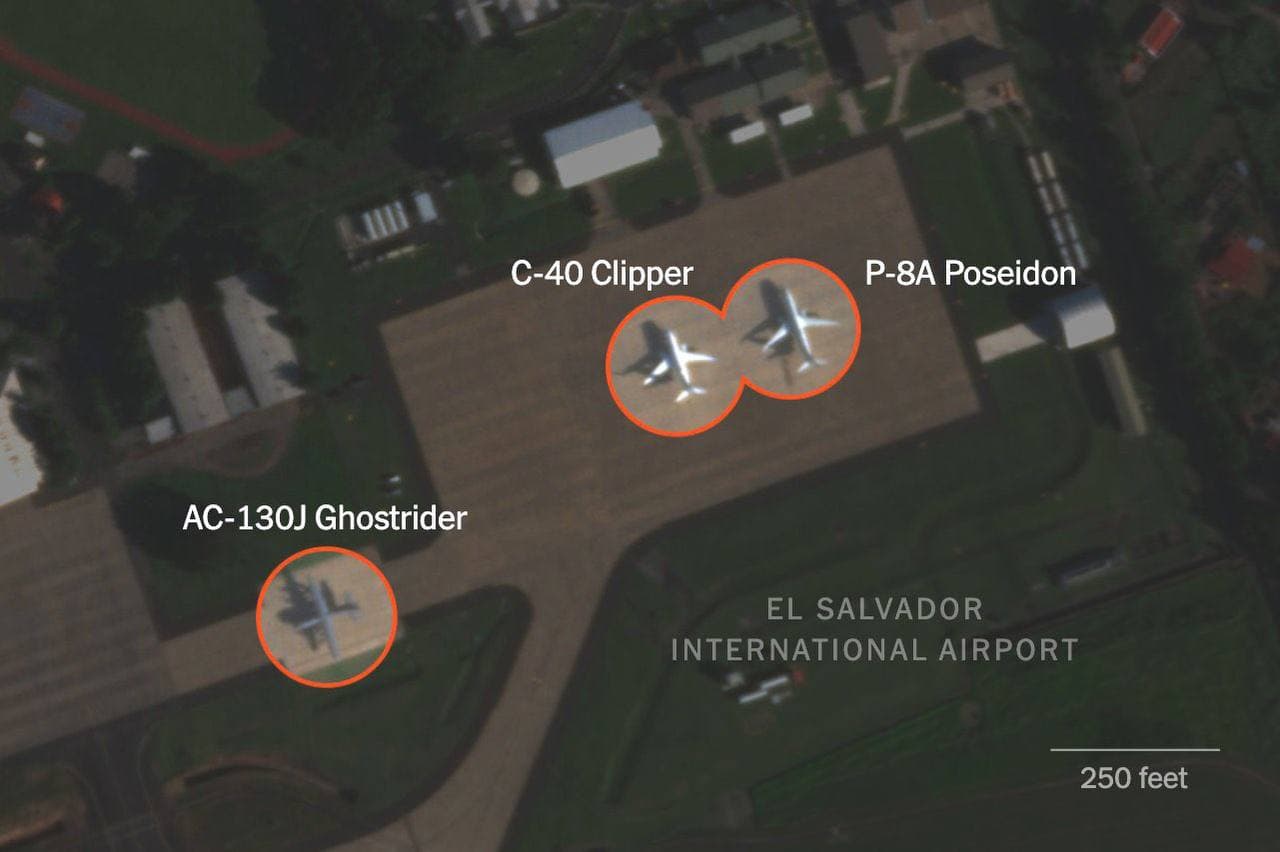
In a significant development in the ongoing fight against drug trafficking in Latin America, the Trump Administration has expanded its military presence in El Salvador. Recent satellite imagery, obtained by the New York Times, reveals the presence of at least three military aircraft at the Cooperative Security Location Comalapa, situated at El Salvador International Airport. This move is part of a larger military buildup in the region aimed at combating drug cartels.
Key Details
The satellite imagery indicates that the aircraft stationed at Comalapa include a U.S. Navy P-8A “Poseidon” Maritime Patrol and Surveillance Aircraft, a C-40 “Clipper” Transport Aircraft, and an AC-130J “Ghostrider” Ground-Attack Gunship, which is operated by U.S. Special Operations Command (SOCOM). These aircraft are part of the U.S. Southern Command (SOUTHCOM) operations, which focus on supporting counter-drug initiatives across Central America and the Caribbean.
The P-8A “Poseidon” is designed for anti-submarine warfare and maritime patrol missions, enhancing the U.S. Navy"s capabilities in monitoring and securing maritime routes that are often exploited by drug traffickers. The C-40 “Clipper” serves as a transport aircraft, facilitating the movement of personnel and equipment, while the AC-130J “Ghostrider” is equipped with advanced weaponry and surveillance systems, making it a formidable asset for ground-attack operations.
Cooperative Security Location Comalapa is one of two joint military sites operated by SOUTHCOM in the region, underscoring the strategic importance of El Salvador in U.S. military operations aimed at curbing drug trafficking. The presence of these aircraft at such a location highlights the ongoing commitment of the U.S. to enhance security and stability in Central America.
Background
The Trump Administration"s military buildup in Latin America has been a response to the escalating challenges posed by drug trafficking organizations. These cartels have increasingly utilized Central American countries as transit points for narcotics destined for the United States. By bolstering military resources in the region, the U.S. aims to disrupt these trafficking routes and reduce the influence of organized crime.
El Salvador has faced significant challenges related to gang violence and drug trafficking, making U.S. support crucial for local law enforcement and military efforts. The deployment of advanced military aircraft is expected to enhance surveillance capabilities and operational effectiveness in countering these threats.
What"s Next
The expansion of military resources in El Salvador is likely to have implications for U.S.-Latin America relations, particularly in terms of security cooperation. As previously reported, similar military operations have been conducted in the Caribbean, with U.S. Marine Corps F-35B Lightning IIs recently conducting operations in the region. This ongoing military engagement reflects a broader strategy to address security challenges in Latin America.
As the situation evolves, the effectiveness of these military assets in combating drug trafficking and supporting local governments will be closely monitored. The U.S. commitment to counter-drug operations in the region indicates a long-term strategy to stabilize areas affected by narcotics-related violence.
For more information on related military operations, see our coverage on recent developments in the Caribbean.


