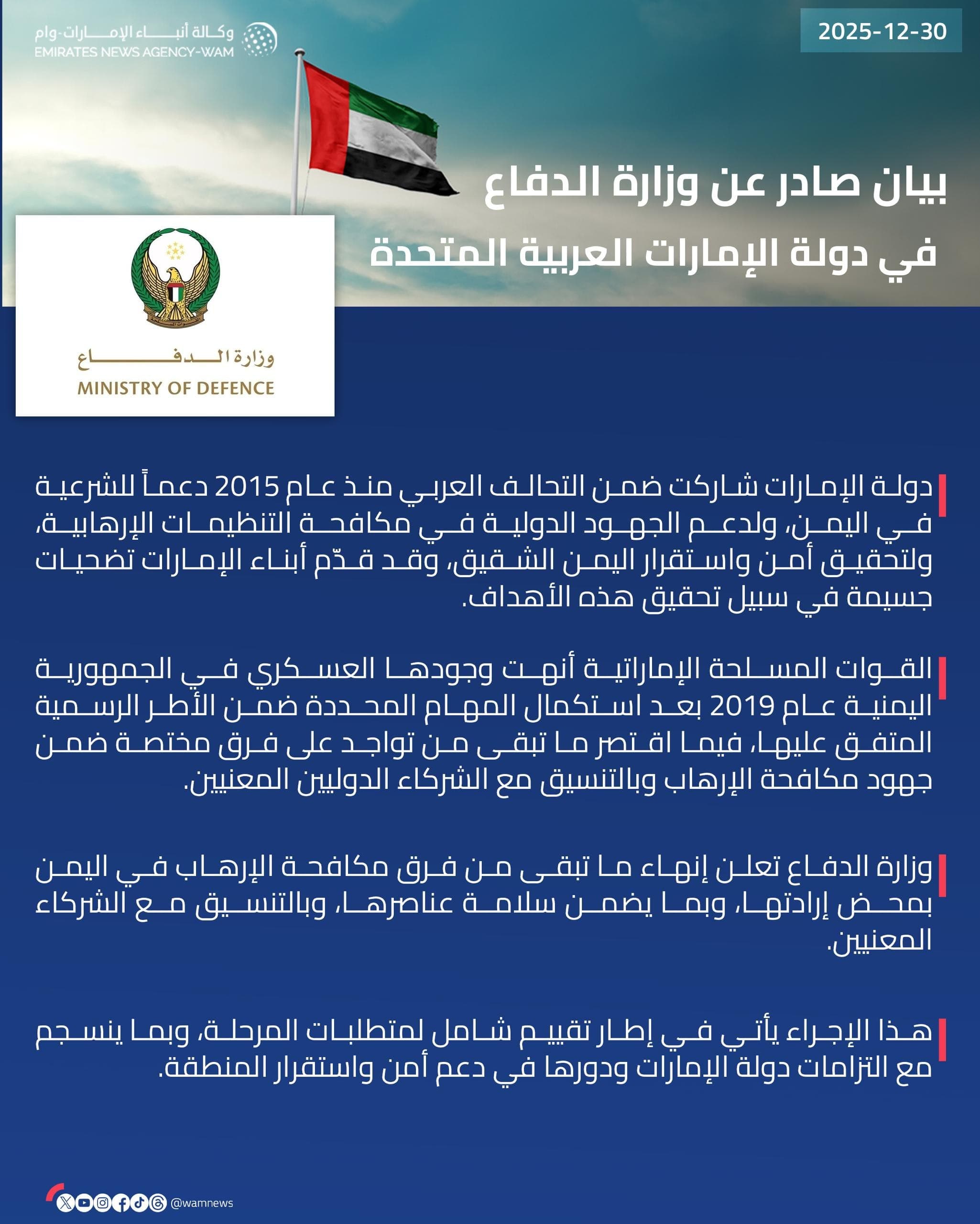
UAE Ministry of Defence Ends Counterterrorism Mission in Yemen
On December 30, 2025, the United Arab Emirates (UAE) Ministry of Defence announced the voluntary termination of its remaining counterterrorism units" mission in Yemen. This decision follows a thorough assessment of recent developments in the region, highlighting the UAE"s evolving military strategy and its response to the changing dynamics of the Yemeni conflict.
Key Details
The UAE"s announcement comes amid escalating tensions in Yemen, particularly following a Saudi-led coalition airstrike on the Mukalla port. This airstrike is part of ongoing military operations in the region, which have drawn international scrutiny and raised concerns about the humanitarian impact on the Yemeni population. The UAE"s statement indicated that while the counterterrorism mission is concluding, limited coordination teams may remain in place as necessary. This decision aligns with the UAE"s broader commitments to regional security and stability.
The UAE has been involved in Yemen since 2015, part of a coalition led by Saudi Arabia aimed at restoring the internationally recognized government of President Abdrabbuh Mansur Hadi, which was ousted by Houthi rebels. The UAE"s military role has included counterterrorism operations targeting groups such as Al-Qaeda in the Arabian Peninsula (AQAP) and the Islamic State (ISIS), which have exploited the chaos of the civil war to gain a foothold in the region.
In its statement, the UAE did not specify a timeline for the withdrawal of its counterterrorism units, nor did it provide details on the number of personnel involved. However, the mention of maintaining limited coordination teams suggests a continued, albeit reduced, presence in Yemen to monitor and respond to security threats as they arise.
Background
The conflict in Yemen has been ongoing since 2014, resulting in one of the world"s worst humanitarian crises. The war has led to widespread famine, disease, and displacement, with millions of Yemenis in need of humanitarian assistance. The UAE"s involvement has been controversial, with reports of human rights abuses and civilian casualties linked to coalition airstrikes. The decision to end the counterterrorism mission reflects a potential shift in the UAE"s military focus, possibly influenced by both domestic and international pressures to reassess its role in the conflict.
In recent months, there have been increasing calls for Emirati forces to withdraw from Yemen, as the situation on the ground continues to evolve. The termination of the counterterrorism mission may signal a broader strategic recalibration by the UAE, as it seeks to balance its military commitments with diplomatic efforts to stabilize the region.
What"s Next
The UAE"s decision to conclude its counterterrorism mission in Yemen raises questions about the future of security in the region. With the withdrawal of Emirati forces, there are concerns about the potential resurgence of terrorist groups in the absence of a robust counterterrorism presence. The limited coordination teams that may remain could play a crucial role in monitoring developments and providing support to local forces.
As previously reported, the situation in Yemen remains fluid, and the international community will be watching closely to see how the UAE"s withdrawal impacts the ongoing conflict and humanitarian situation. The UAE"s military strategy in Yemen will likely continue to evolve as it navigates the complex geopolitical landscape of the Middle East.
For more on related coverage, see our article on Zelensky"s demands for U.S. security guarantees, which highlights similar geopolitical tensions affecting international military commitments.
![[Video] Israeli army conducts demolition operations in Rafah, south Gaza](/_next/image?url=%2Fapi%2Fimage%2Fthumbnails%2Fthumbnail-1767121846051-l1pttg-thumbnail.jpg&w=3840&q=75)

![[Video] Erdogan condemns Israel's recognition of Somaliland as illegal act](/_next/image?url=%2Fapi%2Fimage%2Fthumbnails%2Fthumbnail-1767113456778-rly4dv-thumbnail.jpg&w=3840&q=75)