U.S. Military Deploys Advanced Aircraft to Puerto Rico for Caribbean Operations
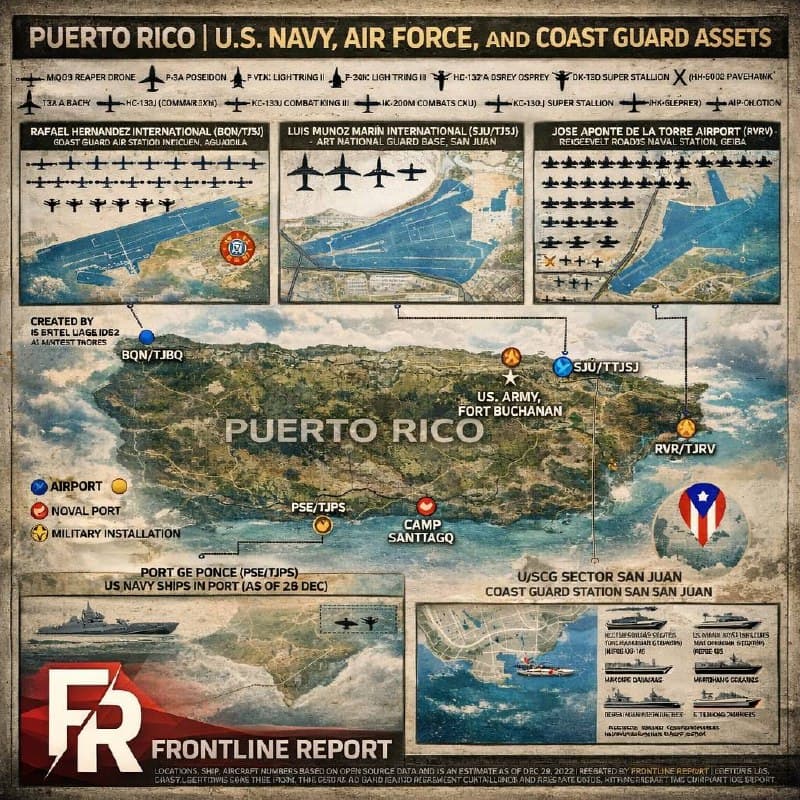
On December 29, 2025, the United States military announced a significant enhancement of its aerial combat and special operations capabilities in the Caribbean region through the deployment of advanced aircraft to bases in Puerto Rico. This strategic move aims to bolster U.S. military presence and operational readiness in response to evolving security challenges in the area.
Key Details
The deployment includes a diverse array of aircraft designed for various operational roles. Among the advanced systems being sent to Puerto Rico are:
- MQ-9A Reaper Drone: An unmanned aerial vehicle (UAV) primarily used for intelligence, surveillance, and reconnaissance (ISR) missions, as well as precision strikes.
- P-8A Poseidon: A multi-mission maritime aircraft used for anti-submarine warfare, anti-surface warfare, and intelligence, surveillance, and reconnaissance missions.
- F-35A Lightning II: A fifth-generation stealth multirole fighter aircraft designed for ground attack and air superiority missions.
- F-35B Lightning II: A variant of the F-35 designed for short takeoff and vertical landing (STOVL), allowing it to operate from smaller bases and aircraft carriers.
- CV-22B Osprey: A tiltrotor aircraft used for special operations, capable of vertical takeoff and landing, combining the functionality of a helicopter with the speed of a fixed-wing aircraft.
- MV-22B Osprey: Similar to the CV-22B, this variant is primarily used for troop transport and logistical support.
- CH-53E Super Stallion: A heavy-lift helicopter used for troop transport and logistical support in challenging environments.
- HH-60W Jolly Green II: A combat rescue helicopter designed to recover personnel in hostile environments.
- E-11A BACN: A battlefield airborne communications node that enhances situational awareness and communication capabilities across various platforms.
- MC-130J Commando II: A specialized transport aircraft used for special operations missions, including infiltration and exfiltration of personnel.
- HC-130J Combat King II: A variant of the C-130 designed for search and rescue missions, equipped with advanced sensors and refueling capabilities.
- EC-130H Compass Call: An electronic warfare aircraft that disrupts enemy communications and radar.
- KC-130J Super Hercules: A refueling aircraft that supports various military operations by extending the range of combat aircraft.
- AH-1Z Cobra: An attack helicopter designed for close air support and anti-armor operations.
- UH-1Y Venom: A utility helicopter that supports troop transport and medical evacuation missions.
This comprehensive array of aircraft is intended to enhance the U.S. military"s ability to conduct operations in the Caribbean, ensuring rapid response capabilities and improved operational flexibility in the region.
Background
The decision to deploy these advanced aircraft comes amid increasing concerns over security in the Caribbean, where geopolitical tensions and various threats have prompted the U.S. to reassess its military posture. The Caribbean region has seen a rise in drug trafficking, human smuggling, and other illicit activities that pose challenges to regional stability. By reinforcing its military presence, the U.S. aims to deter potential threats and support allied nations in maintaining security.
What"s Next
The deployment of these advanced aircraft is expected to enhance the U.S. military"s operational capabilities in the Caribbean significantly. As previously reported, similar situations have arisen in other regions, prompting military adjustments to address emerging threats. The U.S. military will likely continue to monitor developments closely and adapt its strategies to ensure readiness in the face of evolving challenges.
For more information on related developments, see our coverage of China"s support for Somalia"s sovereignty and recent
![[Video] At least 13 dead as train derails in Mexico](/_next/image?url=%2Fapi%2Fimage%2Fthumbnails%2Fthumbnail-1767005514578-qno3q-thumbnail.jpg&w=3840&q=75)
![[Video] At least 13 dead and 98 injured in Oaxaca train derailment](/_next/image?url=%2Fapi%2Fimage%2Fthumbnails%2Fthumbnail-1767005478912-77f4ila-thumbnail.jpg&w=3840&q=75)
![[Video] Clash in Yalova province leaves 3 police officers dead, 6 terrorists neutralized](/_next/image?url=%2Fapi%2Fimage%2Fthumbnails%2Fthumbnail-1767003655103-ejv865-thumbnail.jpg&w=3840&q=75)
![[Video] China supports Somalia’s sovereignty, reunification, and territorial integrity](/_next/image?url=%2Fapi%2Fimage%2Fthumbnails%2Fthumbnail-1767003639552-kk2vpa-thumbnail.jpg&w=3840&q=75)

![[Video] Iran's Rial Plummets to Record Low of 1.45 Million Rials per Dollar](/_next/image?url=%2Fapi%2Fimage%2Fthumbnails%2Fthumbnail-1767004876787-pfsvo8-thumbnail.jpg&w=3840&q=75)