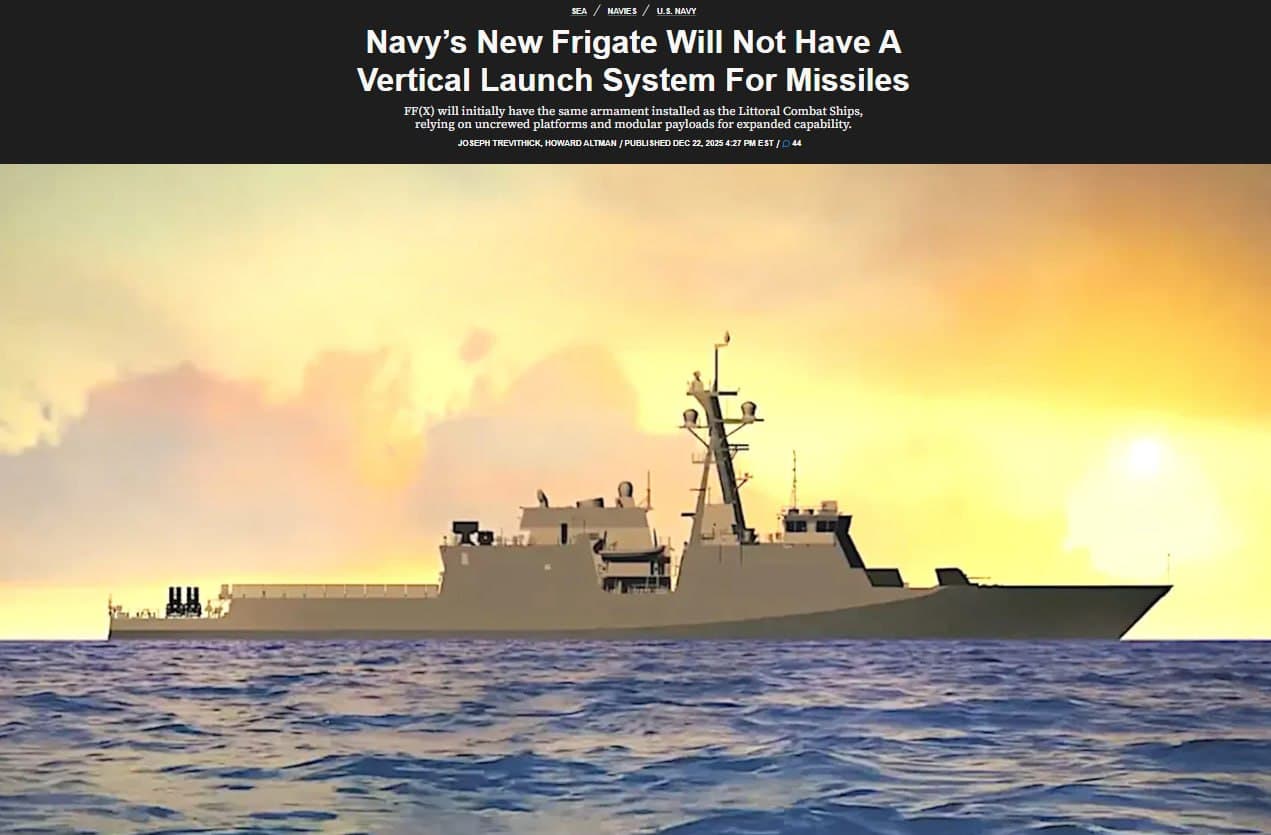
U.S. Navy"s New Frigate Class Will Not Include Vertical Launch System
In a recent announcement, the U.S. Navy confirmed that the first "flight" of its newly unveiled frigate class will not be equipped with a built-in Vertical Launch System (VLS). This decision was communicated to The War Zone, a defense-focused media outlet, highlighting a significant aspect of the Navy"s evolving naval capabilities.
Key Details
The frigates were officially unveiled on December 19, 2025, by Secretary of the Navy John Phelan. These vessels are designed to enhance the Navy"s operational capabilities and are based on the U.S. Coast Guard’s Legend-Class National Security Cutter. The construction of these frigates will take place at Huntington Ingalls Industries, a major American shipbuilding company located in Pascagoula, Mississippi.
Instead of incorporating a Vertical Launch System, which is commonly used for launching missiles and other munitions from naval vessels, the initial configuration of these frigates will feature an armament suite similar to that found on the U.S. Navy’s Littoral Combat Ships (LCS). Specifically, this armament configuration will draw from the capabilities of both the Freedom-class and Independence-class Littoral Combat Ships, which are designed for operations close to shore and have been integral to the Navy"s recent maritime strategies.
Background
The decision to exclude a Vertical Launch System from the initial frigate configuration marks a strategic choice by the Navy, reflecting its focus on versatility and adaptability in modern naval warfare. The Littoral Combat Ships, which have faced scrutiny regarding their effectiveness in various combat scenarios, have been a topic of discussion in defense circles. By adopting a similar armament suite, the Navy aims to leverage existing technologies and operational experiences while potentially addressing some of the concerns raised about the LCS program.
The Legend-Class National Security Cutter, which serves as the foundation for the new frigate class, is known for its robust design and multi-mission capabilities, including law enforcement, search and rescue, and national defense operations. This lineage suggests that the new frigates will be built with a focus on both operational effectiveness and survivability in diverse maritime environments.
What"s Next
As the U.S. Navy continues to develop this new class of frigates, the implications of not including a Vertical Launch System will be closely monitored by defense analysts and military strategists. The decision may influence future naval engagements and the overall strategic posture of the U.S. Navy in global waters. The Navy"s commitment to building these frigates at Huntington Ingalls Industries also underscores the importance of domestic shipbuilding capabilities in supporting national defense initiatives.
For those interested in related developments, the Navy"s ongoing modernization efforts can be contextualized within the broader framework of military enhancements, including the recent announcements regarding new classes of ships, such as the proposed "Trump Class" Navy ships, which were discussed by former President Trump in earlier coverage. These developments reflect a continuous evolution in naval strategy and capabilities, as the U.S. seeks to maintain its maritime superiority.
For more information on recent developments in naval shipbuilding and military strategy, see our coverage on President Trump to announce new "Trump Class" Navy ships at Mar-a-Lago.
![[Video] Trump criticizes Colombian President Petro over cocaine factories](/_next/image?url=%2Fapi%2Fimage%2Fthumbnails%2Fthumbnail-1766445089650-kjy36-thumbnail.jpg&w=3840&q=75)

![[Video] Trump claims Greenland is hosting Chinese and Russian ships](/_next/image?url=%2Fapi%2Fimage%2Fthumbnails%2Fthumbnail-1766445049285-llfqt-thumbnail.jpg&w=3840&q=75)

![[Video] Trump suggests Maduro should consider stepping down in Venezuela](/_next/image?url=%2Fapi%2Fimage%2Fthumbnails%2Fthumbnail-1766446856703-m0ac-thumbnail.jpg&w=3840&q=75)
![[Video] Trump: It is a counter to everybody, not China](/_next/image?url=%2Fapi%2Fimage%2Fthumbnails%2Fthumbnail-1766446844680-ruz953-thumbnail.jpg&w=3840&q=75)
![[Video] Trump: Land strikes not just in Venezuela, but anywhere drugs are pouring in](/_next/image?url=%2Fapi%2Fimage%2Fthumbnails%2Fthumbnail-1766446270676-q44n0a-thumbnail.jpg&w=3840&q=75)