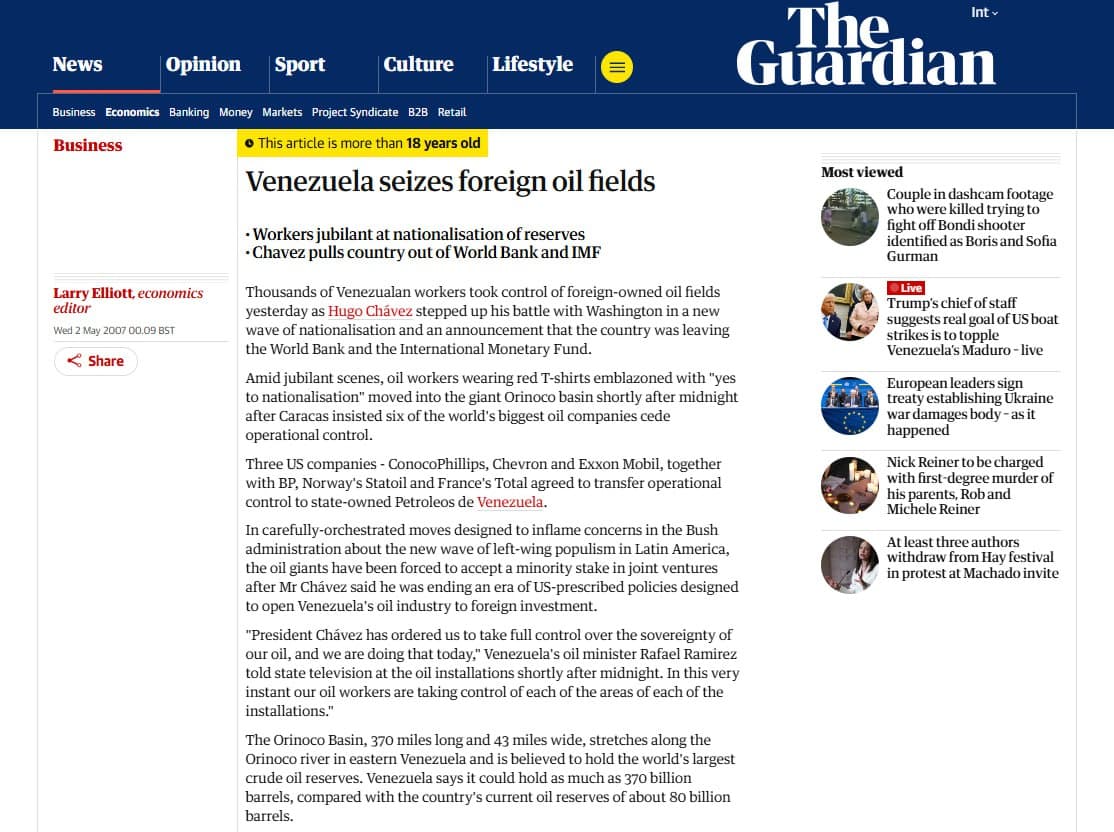
Venezuela Seizes Foreign Oil Fields, Nationalizes Operations
On May 1, 2007, coinciding with International Workers" Day, Venezuela initiated a significant move in its ongoing battle against foreign influence by seizing control of foreign-owned oil fields. This action was part of President Hugo Chávez"s broader strategy to nationalize key sectors of the economy, particularly the oil industry, which is crucial for the nation"s financial stability. The announcement also included Venezuela"s decision to withdraw from the World Bank and the International Monetary Fund (IMF), marking a decisive shift in the country’s economic policies.
Key Details
Thousands of Venezuelan oil workers, donning red T-shirts with the slogan "yes to nationalisation," took control of the oil fields in the Orinoco basin shortly after midnight on May 1. This operation was part of a larger directive from the Venezuelan government, which demanded that six of the world"s largest oil companies relinquish operational control of their assets in the country. The companies involved included three major U.S. firms: ConocoPhillips, Chevron, and Exxon Mobil, along with BP from the United Kingdom, Statoil from Norway, and Total from France.
The Venezuelan state-owned oil company, Petroleos de Venezuela (PDVSA), was designated to take over the operational control of these oil fields. This move was seen as a culmination of Chávez"s long-standing campaign against what he termed "imperialist" interests in Venezuela"s natural resources. The nationalization effort was celebrated by many in Venezuela as a victory for workers and a step toward greater economic independence.
Background
The nationalization of the oil industry was a key component of Chávez"s political platform, which emphasized the redistribution of wealth and resources to benefit the Venezuelan populace. The Orinoco basin is one of the richest oil reserves in the world, and control over these resources has been a contentious issue between the Venezuelan government and foreign corporations. Chávez"s administration had previously engaged in negotiations with these companies, but tensions escalated as the government sought to increase its share of oil revenues.
By announcing the withdrawal from the World Bank and the IMF, Chávez signaled a rejection of the neoliberal economic policies advocated by these institutions, which he argued had contributed to Venezuela"s economic struggles. This decision was part of a broader trend in Latin America during the early 2000s, where several countries began to distance themselves from international financial institutions in favor of more state-controlled economic models.
What"s Next
The implications of this nationalization are profound for Venezuela"s economy and its relationship with foreign investors. By taking control of its oil fields, Venezuela aimed to increase its revenue from oil exports, which are vital for funding social programs and stabilizing the economy. However, this move also risked alienating foreign investors and could lead to legal battles over the expropriation of assets. The long-term effects of this decision would unfold in the years to come, as Venezuela navigated the challenges of managing its oil resources independently while facing international scrutiny and potential sanctions.
As previously reported, similar situations have arisen in other countries where governments have sought to reclaim control over natural resources from foreign corporations. The nationalization of oil fields in Venezuela serves as a significant case study in the ongoing debate over resource sovereignty and economic independence in the global context.



![[Video] Trump says he brought notes for speech due to his support for Israel](/_next/image?url=%2Fapi%2Fimage%2Fthumbnails%2Fthumbnail-1765938647912-zz610f-thumbnail.jpg&w=3840&q=75)