Title: Xiomara Castro Calls for Peaceful Protests in Tegucigalpa Against Alleged Coup Attempt
Author: Dr. Ananya Sharma
Date: December 16, 2025
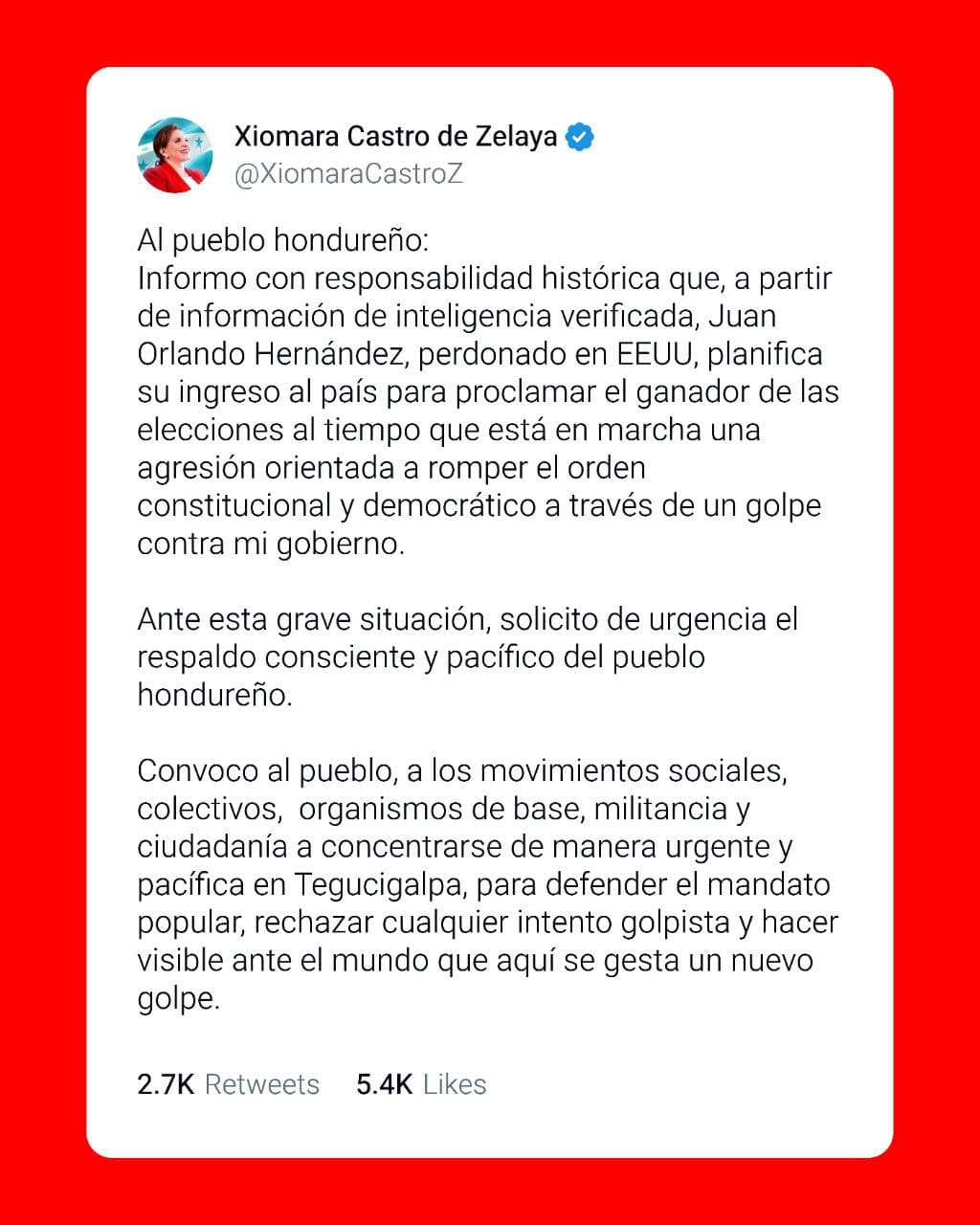
In a dramatic appeal to the Honduran populace, President Xiomara Castro, alongside former President Manuel Zelaya, has called for peaceful protests in the capital city of Tegucigalpa. This call comes amid allegations of an impending coup aimed at destabilizing her government, which she claims is a victim of a conspiracy orchestrated by former President Juan Orlando Hernández. Castro"s statements were made public via her social media account on the platform X, where she urged citizens to mobilize in defense of democracy and the electoral mandate.
Key Details
President Xiomara Castro, who leads a leftist government in Honduras, has expressed grave concerns regarding the political stability of her administration. In her announcement, she cited "verified intelligence information" indicating that Juan Orlando Hernández, who was previously pardoned in the United States, is allegedly planning to return to Honduras. Castro claims that Hernández"s return is part of a larger scheme to undermine her presidency by proclaiming the winner of the recent elections, which she asserts would violate the constitutional order of the nation.
In her message, Castro stated, "To the Honduran people: I inform, with historical responsibility, that based on verified intelligence information, Juan Orlando Hernández... is planning to enter the country to proclaim the winner of the elections." This assertion raises significant concerns about the legitimacy of the electoral process and the potential for civil unrest in the country.
Castro"s call to action is directed towards a wide array of groups, including social movements, collectives, grassroots organizations, and individual citizens. She urged these groups to gather "urgently and peacefully" in Tegucigalpa to defend what she describes as the "popular mandate" and to reject any attempts at a coup. Her appeal emphasizes the need for a united front against what she perceives as an aggressive maneuver to disrupt the democratic framework of Honduras.
Background
Xiomara Castro assumed the presidency of Honduras in January 2022, becoming the first female president in the country"s history. Her administration has faced numerous challenges, including economic difficulties, corruption allegations, and political opposition. The political landscape in Honduras has been tumultuous, particularly following the presidency of Juan Orlando Hernández, who served from 2014 until 2022 and was implicated in various corruption scandals during his tenure. Hernández"s administration was marked by accusations of human rights abuses and electoral fraud, leading to widespread protests and political unrest.
The current political climate is further complicated by the historical context of coups in Honduras, including the 2009 coup that ousted Manuel Zelaya, Castro"s husband. This history of political instability adds weight to Castro"s claims of a potential coup, as the country grapples with its legacy of military intervention in governance.
What"s Next
The situation in Honduras remains fluid, with Castro"s call for peaceful protests likely to mobilize her supporters and potentially escalate tensions with opposition groups. The international community is closely monitoring the developments, as any significant unrest could have broader implications for regional stability in Central America. Castro"s administration is expected to continue advocating for democratic processes and may seek support from international allies to counteract any perceived threats to her government.
As previously reported, similar situations have unfolded in various countries where political leaders face challenges to their authority, highlighting the delicate balance between governance and civil unrest. The outcome of this situation in Honduras will be critical in determining the future of its democratic institutions and the rule of law.
For further reading on related coverage, see our article on recent developments in political funding and its implications.
![[Video] Netanyahu demands Western countries act against antisemitism now](/_next/image?url=%2Fapi%2Fimage%2Fthumbnails%2Fthumbnail-1765920642580-phmls-thumbnail.jpg&w=3840&q=75)
![[Video] Argentina's President Javier Milei meets Chile's President-elect José Antonio Kast](/_next/image?url=%2Fapi%2Fimage%2Fthumbnails%2Fthumbnail-1765915258310-0vncp-thumbnail.jpg&w=3840&q=75)
![[Video] President Javier Milei and President-elect Jose Antonio Kast promote freedom](/_next/image?url=%2Fapi%2Fimage%2Fthumbnails%2Fthumbnail-1765915242466-x7h0sd-thumbnail.jpg&w=3840&q=75)
![[Video] President Trump restricts entry of foreign nationals to protect U.S. security](/_next/image?url=%2Fapi%2Fimage%2Fthumbnails%2Fthumbnail-1765925476990-qyuuqy-thumbnail.jpg&w=3840&q=75)