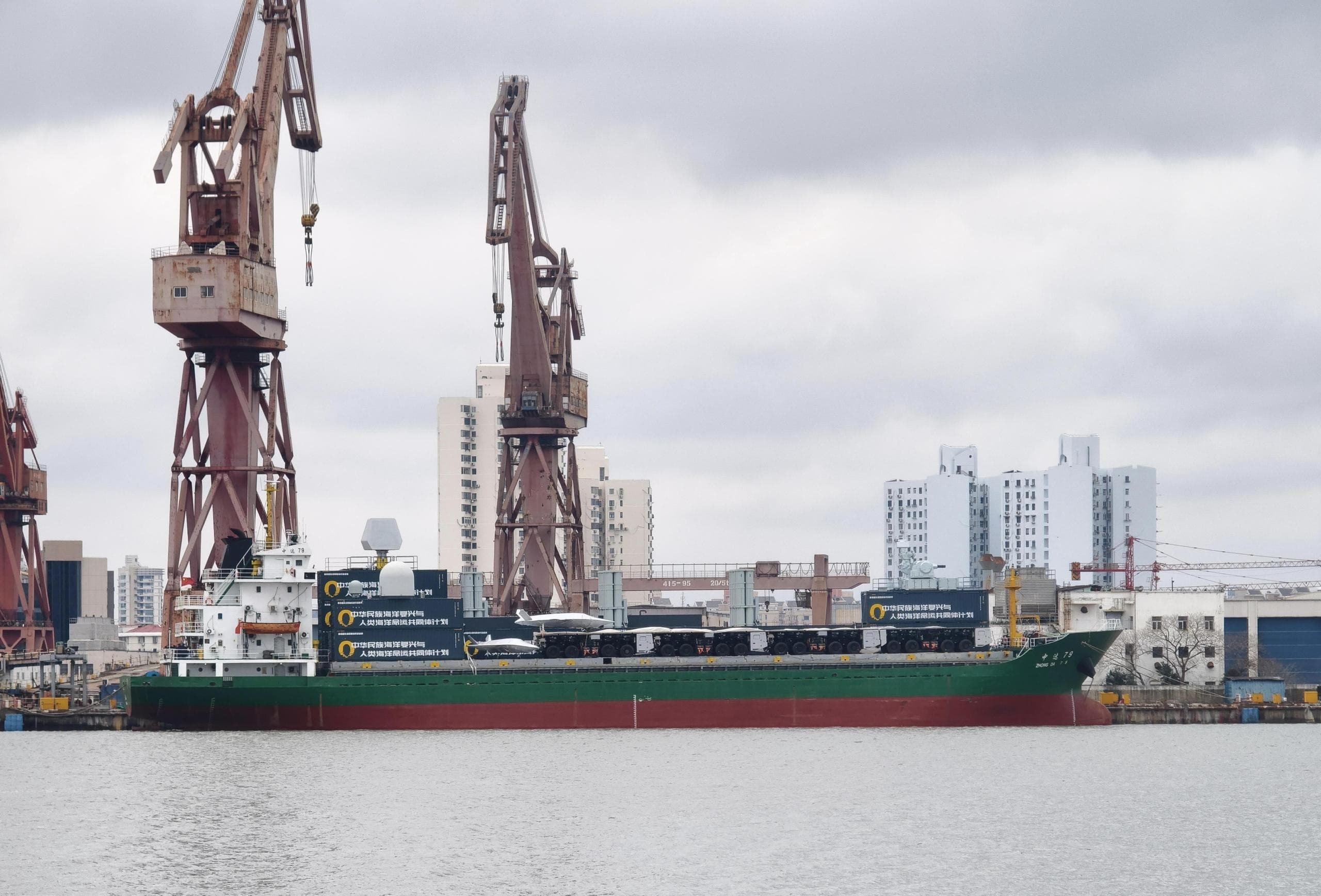
China Tests Truck-Mounted Electromagnetic Catapult on Container Ship
Recent developments from the Hudong-Zhonghua shipyard in Shanghai, China, have unveiled a significant advancement in military technology. Images captured in late December 2025 show a modular, truck-mounted electromagnetic catapult system installed on the container ship Zhong Da 79. This vessel has previously been observed equipped with containerized missile launchers and various defense systems. The implications of this development suggest that China is actively exploring the conversion of merchant vessels into auxiliary drone carriers capable of launching fixed-wing unmanned aerial vehicles (UAVs).
Key Details
The Hudong-Zhonghua shipyard, located in Shanghai, is one of China"s leading shipbuilding facilities, known for its advanced technological capabilities. The shipyard has been involved in various military and commercial projects, contributing to China"s growing naval power.
The container ship Zhong Da 79, which is at the center of this development, has been previously documented with missile launchers and defense systems, indicating its dual-use potential. The addition of the truck-mounted electromagnetic catapult system represents a significant enhancement in its operational capabilities. This system allows for the rapid launch of UAVs, which can be utilized for reconnaissance, surveillance, and potentially offensive operations.
Reports from reputable outlets such as The War Zone and the South China Morning Post have highlighted this development, emphasizing its strategic importance. The testing of such a system on a merchant vessel underscores China"s innovative approach to expanding its military capabilities without the need for traditional naval vessels.
Background
The concept of converting commercial ships into military assets is not new, but China"s recent advancements signify a shift in how naval warfare may be conducted in the future. The integration of drone technology into existing maritime infrastructure allows for greater flexibility and responsiveness in military operations. The use of electromagnetic catapults, which utilize electromagnetic forces to launch objects at high speeds, represents a cutting-edge technology that could enhance the operational range and effectiveness of UAVs.
As previously reported, the global military landscape is evolving, with nations seeking innovative solutions to enhance their defense capabilities. China"s focus on integrating advanced technologies into its naval fleet reflects its ambition to assert itself as a dominant maritime power in the Asia-Pacific region.
What"s Next
The successful testing of the truck-mounted electromagnetic catapult on the Zhong Da 79 could have far-reaching implications for military strategy and maritime operations. If this technology proves effective, it may lead to the development of a new class of hybrid vessels that combine commercial and military functionalities. This could alter the dynamics of naval engagements, particularly in contested regions where rapid deployment of UAVs is critical.
Furthermore, this development may prompt other nations to explore similar technologies, potentially leading to an arms race in maritime drone capabilities. As the geopolitical landscape continues to shift, the integration of advanced technologies into naval operations will likely play a crucial role in shaping future conflicts.
In conclusion, the recent advancements in China"s military capabilities, particularly the testing of the truck-mounted electromagnetic catapult system on the Zhong Da 79, highlight the ongoing evolution of naval warfare and the increasing importance of drone technology in modern military strategy.



![[Video] Joint Task Force Southern Spear kills five narco-terrorists in strike](/_next/image?url=%2Fapi%2Fimage%2Fthumbnails%2Fthumbnail-1767249647038-yp58m6-thumbnail.jpg&w=3840&q=75)
![[Video] Demonstrations in Iran target clerical rule as security forces respond](/_next/image?url=%2Fapi%2Fimage%2Fthumbnails%2Fthumbnail-1767273644736-gkv6uv-thumbnail.jpg&w=3840&q=75)