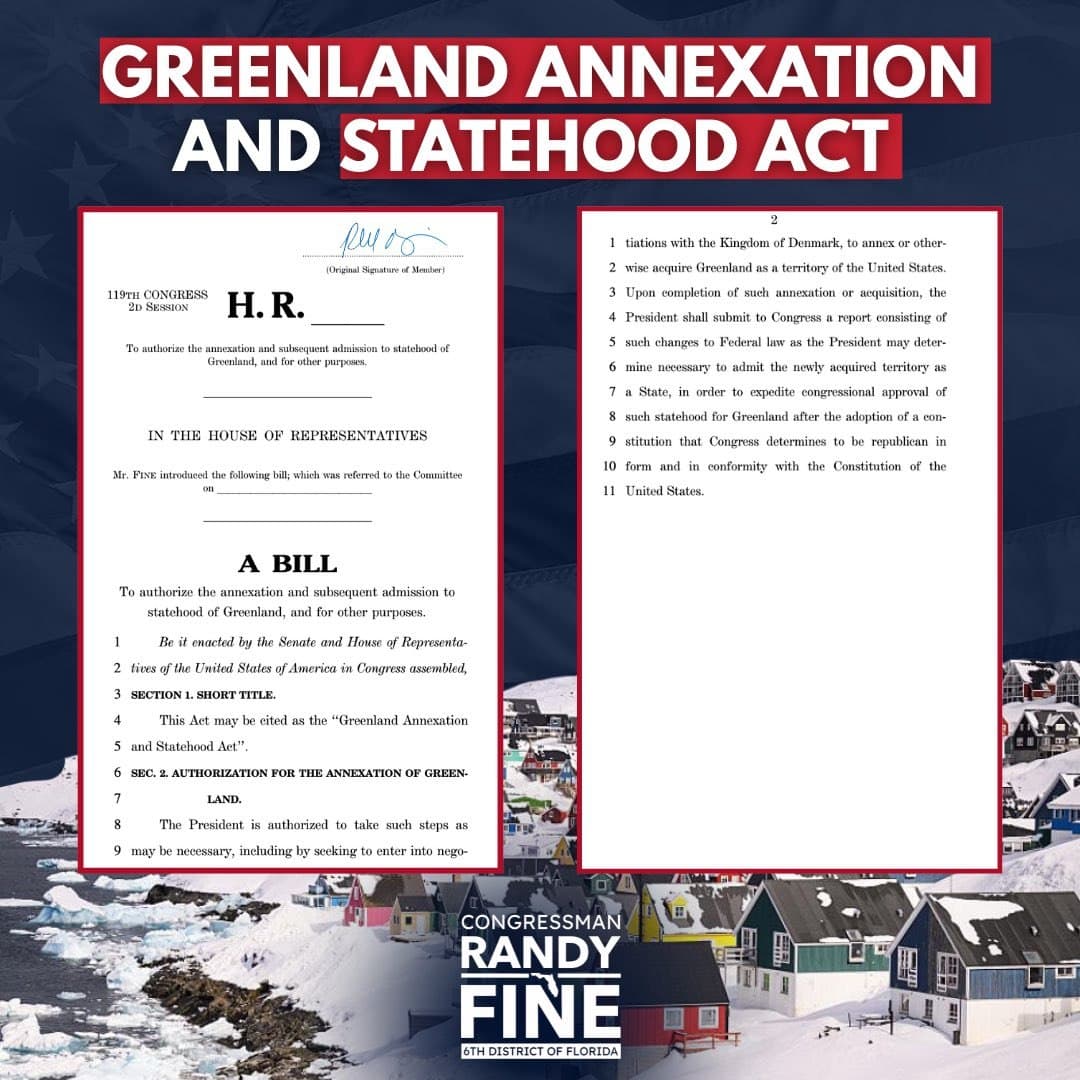
Congressman Randy Fine Introduces Bill to Annex Greenland
On January 12, 2026, Congressman Randy Fine, a Republican representative from Florida, announced the introduction of the Greenland Annexation and Statehood Act. This proposed legislation aims to empower the President of the United States to explore and implement the necessary measures to incorporate Greenland into the Union. Fine"s initiative is framed within the context of national security concerns regarding the Arctic region, particularly in light of perceived threats from geopolitical adversaries.
Key Details
Congressman Randy Fine"s bill, formally titled the Greenland Annexation and Statehood Act, seeks to facilitate the annexation of Greenland, an autonomous territory of Denmark. Fine emphasized the strategic importance of Greenland, stating, "Let me be clear, our adversaries are trying to establish a foothold in the Arctic, and we can’t let that happen." His comments reflect a growing concern among U.S. lawmakers regarding the influence of countries like Russia and China in the Arctic, a region rich in natural resources and significant for military strategy.
Fine"s assertion highlights the urgency he feels regarding U.S. interests in the Arctic. He argues that by acquiring Greenland, the United States would not only prevent adversaries from gaining control over this vital area but also secure its northern flank against potential threats from both Russia and China. The Arctic has become increasingly important due to climate change, which has made previously inaccessible areas navigable and opened up new shipping routes and resource extraction opportunities.
Background
The introduction of the Greenland Annexation and Statehood Act is not an isolated event; it follows a history of interest in Greenland from the United States. In 2019, former President Donald Trump expressed a desire to purchase Greenland, which was met with strong opposition from Denmark and the Greenlandic government. The current bill by Congressman Fine appears to build on this previous interest, framing the annexation as a strategic necessity rather than merely a commercial transaction.
Greenland, which is the world"s largest island, has a population of approximately 56,000 people, most of whom are indigenous Greenlandic Inuit. The territory has its own government and exercises a degree of autonomy from Denmark, although foreign affairs and defense remain under Danish control. The geopolitical significance of Greenland has been underscored by its location, which is strategically positioned between North America and Europe, making it a focal point for military and economic interests.
What"s Next
The introduction of the Greenland Annexation and Statehood Act raises several questions regarding its feasibility and potential implications. If the bill gains traction in Congress, it will require careful consideration of international law, the rights of the Greenlandic people, and the diplomatic relationship between the United States and Denmark. Additionally, the bill"s passage would necessitate a complex process of negotiation and potential referendums involving the people of Greenland.
As the geopolitical landscape continues to evolve, the Arctic region is expected to remain a focal point of international relations. The U.S. government"s actions regarding Greenland will likely influence its relationships with both allies and adversaries in the region. For further insights on related developments, see our previous reports on the topic.
In conclusion, Congressman Fine"s bill represents a significant step in U.S. legislative efforts to assert influence in the Arctic, reflecting broader concerns about national security and global competition. The outcome of this initiative will be closely monitored by policymakers and analysts alike as it unfolds in the coming months.
![[Video] Heavy clashes between Syrian Arab Army and SDF militia in Al-Mardud](/_next/image?url=%2Fapi%2Fimage%2Fthumbnails%2Fthumbnail-1768257668705-bzba9s-thumbnail.jpg&w=3840&q=75)
![[Video] SDF/YPG militias deploy reinforcements to Deir Hafer front line](/_next/image?url=%2Fapi%2Fimage%2Fthumbnails%2Fthumbnail-1768257654986-e7coft-thumbnail.jpg&w=3840&q=75)

![[Video] Anti-ICE Protester Pepper Sprayed as CBP Agents Disperse Crowd in Minneapolis](/_next/image?url=%2Fapi%2Fimage%2Fthumbnails%2Fthumbnail-1768260677127-y71sb7-thumbnail.jpg&w=3840&q=75)
![[Video] Minneapolis Mayor Jacob Frey calls DHS agents' arrival an 'INVASION'](/_next/image?url=%2Fapi%2Fimage%2Fthumbnails%2Fthumbnail-1768258260467-z8ar1h-thumbnail.jpg&w=3840&q=75)