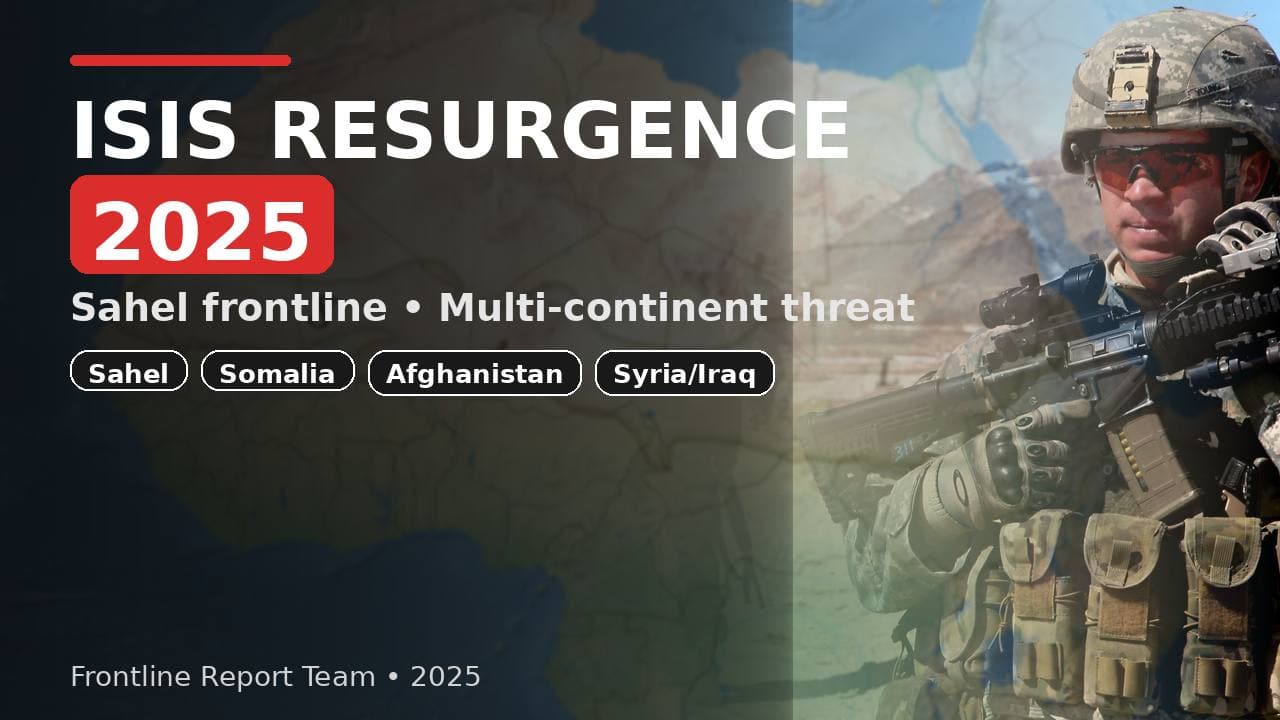
Islamic State Executes Violent Resurgence Across Multiple Continents in 2025
As of December 20, 2025, the Islamic State (ISIS) has been identified as undergoing a significant and violent resurgence across various continents, according to a detailed analysis conducted by a specialized team. This resurgence is marked by intensified military activities, territorial gains, and a strategic exploitation of regional vulnerabilities.
Key Details
The primary battleground for ISIS has shifted to the Sahel region of Africa, where the group is actively engaged in fierce territorial warfare. Reports indicate that ISIS-affiliated provinces in this area have successfully captured numerous towns and have overrun military bases, showcasing their growing operational capabilities. The Sahel, which includes countries like Mali, Niger, and Burkina Faso, has become a focal point for ISIS"s expansion efforts.
In addition to the Sahel, ISIS is also conducting sustained military campaigns in Somalia, Afghanistan, and Central Asia. These regions have seen a resurgence of violence, with ISIS leveraging local conflicts and instability to bolster its presence. Furthermore, the group"s core territories in Syria and Iraq continue to experience a persistent insurgency characterized by bombings and targeted assassinations, indicating that the threat from ISIS remains significant in these historically troubled areas.
The resurgence of ISIS is largely attributed to several key factors. One major element is the exploitation of security vacuums that exist in various regions. As governments struggle to maintain order amid political instability and conflict, ISIS has been able to form local alliances, further entrenching its influence. Additionally, the group has maintained financial independence through methods such as extortion and illicit trade, allowing it to fund its operations and sustain its activities without reliance on external support.
Background
The Islamic State, once considered to be on the decline after significant territorial losses in Iraq and Syria, has managed to adapt and evolve in response to changing geopolitical landscapes. The group"s ability to exploit local grievances and conflicts has allowed it to re-establish itself in regions where state authority is weak or absent. This resurgence poses a renewed threat not only to the immediate regions affected but also to global security, as the group continues to inspire and coordinate attacks beyond its traditional strongholds.
What"s Next
The implications of ISIS"s resurgence are profound. As the group continues to gain ground in the Sahel and other regions, international security agencies are likely to increase their focus on counter-terrorism efforts. The situation calls for a coordinated response from affected nations and international coalitions to address the underlying issues that allow such extremist groups to thrive. The ongoing violence and instability in these regions could potentially lead to broader conflicts, further complicating efforts to achieve peace and stability.
For further reading on related developments, see our coverage on recent developments in international relations and the US government"s recent actions against illicit trade.

![[Video] U.S. Coast Guard seizes oil tanker last docked in Venezuela](/_next/image?url=%2Fapi%2Fimage%2Fthumbnails%2Fthumbnail-1766268127598-k1o5go-thumbnail.jpg&w=3840&q=75)
![[Video] US Coast Guard apprehends oil tanker last docked in Venezuela](/_next/image?url=%2Fapi%2Fimage%2Fthumbnails%2Fthumbnail-1766266889038-8w6bo8-thumbnail.jpg&w=3840&q=75)