Japan"s Ishi Hirai Calls for Nuclear Weapons Development Amid China Threat
In a significant escalation of rhetoric regarding national defense, Ishi Hirai, a member of Japan"s ruling Liberal Democratic Party (LDP), has urged the Japanese government to develop nuclear weapons in response to increasing military threats from China. Hirai"s comments come in the wake of recent military drills conducted by the People"s Liberation Army (PLA) that have effectively encircled Taiwan, raising alarms in Tokyo about regional security.
Key Details
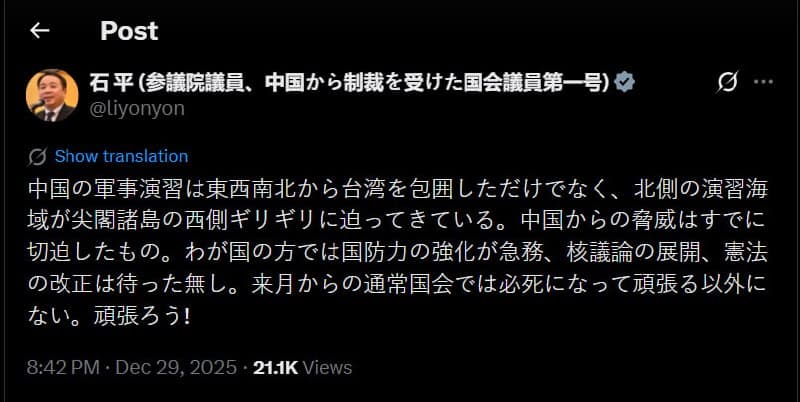
Hirai, who was born Shi Ping in Sichuan Province, China, and is currently sanctioned by the People"s Republic of China (PRC) for his outspoken criticism of the Chinese Communist Party (CCP), emphasized the urgency of strengthening Japan"s national defense. He specifically pointed to the PLA"s military exercises, which have not only surrounded Taiwan from multiple directions—east, west, south, and north—but have also encroached upon the western edge of the Senkaku Islands, a territory claimed by both Japan and China.
In his statements, Hirai declared, "The threat from China has already become imminent. For our country, strengthening national defense is an urgent task; the development of nuclear discussions and constitutional revision cannot wait any longer." This call to action is set against the backdrop of Japan"s pacifist constitution, which has historically limited the country"s military capabilities and nuclear armament.
Hirai"s remarks come ahead of the ordinary session of the Japanese parliament, scheduled to begin next month, where he expressed the need for lawmakers to "desperately strive and give it our all" in addressing these pressing security concerns.
Background
The Senkaku Islands, known as Diaoyu in China, have been a longstanding point of contention between Japan and China, with both nations asserting territorial claims. The recent PLA drills, which have raised tensions in the region, are part of a broader pattern of military assertiveness by China, particularly concerning Taiwan, which Beijing views as a breakaway province. The situation has prompted discussions within Japan about revisiting its post-World War II pacifist stance, which has been enshrined in Article 9 of its constitution.
Hirai"s personal history adds a layer of complexity to his advocacy. As a Chinese national who has become a prominent figure in Japanese politics, his calls for nuclear armament reflect a growing sentiment among some Japanese lawmakers who believe that the country must adapt its defense strategies in light of evolving geopolitical threats.
What"s Next
As Japan prepares for the upcoming parliamentary session, the debate over nuclear weapons and constitutional revision is expected to intensify. Hirai"s statements may galvanize support among those who advocate for a more robust defense posture, particularly in light of the perceived threats from China. The implications of such discussions could lead to significant shifts in Japan"s defense policy and its approach to regional security.
In the context of these developments, the situation surrounding Taiwan remains critical. Recent reports indicate that the Taiwan Coast Guard has been actively intercepting Chinese vessels during military exercises, highlighting the ongoing tensions in the Taiwan Strait. For further insights, see our previous reports on this topic.
As Japan navigates these complex geopolitical waters, the calls for nuclear armament and constitutional reform will likely continue to resonate within the political landscape, shaping the future of Japan"s defense strategy in an increasingly volatile region.

![[Video] Taiwan Coast Guard intercepts Chinese vessel during 'Justice Mission 2025' exercises](/_next/image?url=%2Fapi%2Fimage%2Fthumbnails%2Fthumbnail-1767068445399-4o2agv-thumbnail.jpg&w=3840&q=75)