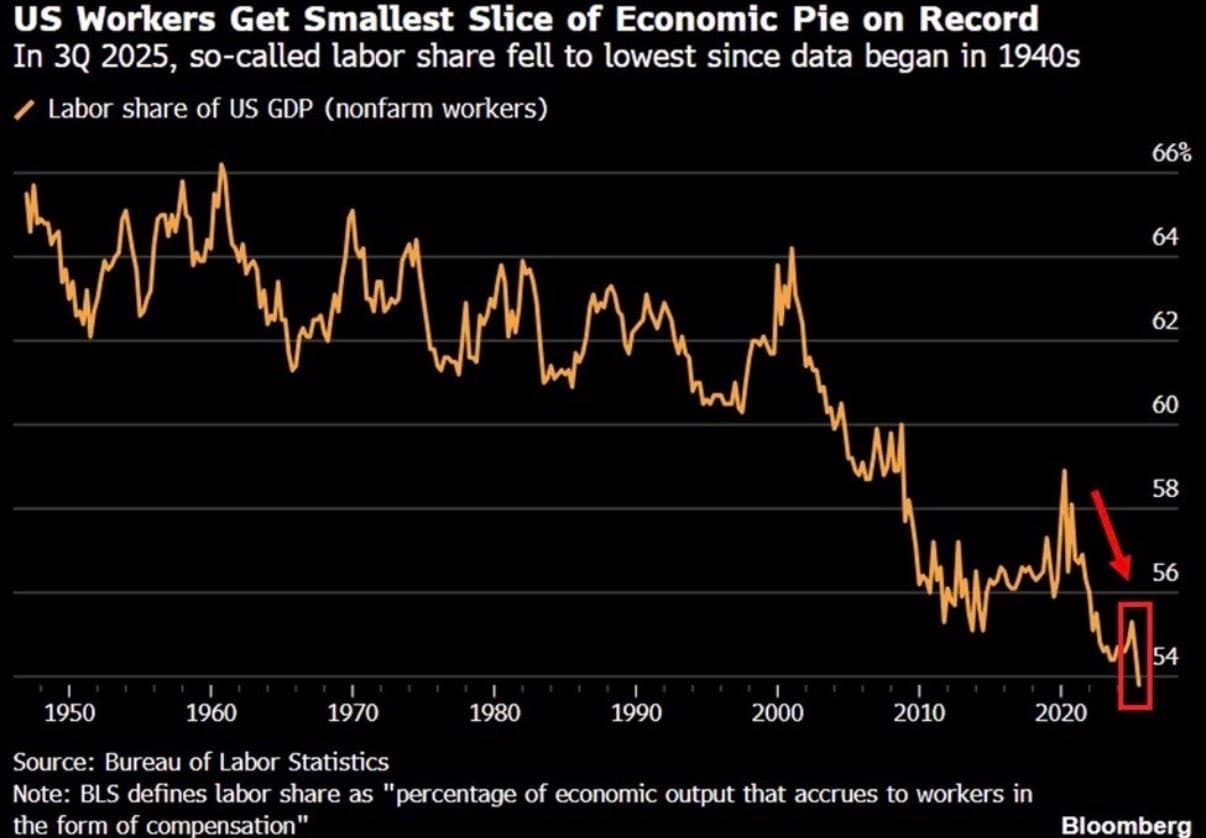
Labor"s Share of GDP Falls to Historic Low of 53.8%
American workers are now receiving a smaller share of the nation"s economic output than at any point in recorded history. According to recent data, labor"s share of Gross Domestic Product (GDP) has plummeted to 53.8%, marking the lowest level since tracking began in 1947. This significant decline highlights a troubling trend in the distribution of national income, particularly over the last two decades.
Key Details
Since the year 2001, the portion of national income allocated to workers has decreased by more than ten percentage points. This decline is particularly concerning as it indicates a growing disparity between the earnings of workers and the profits generated by corporations. In stark contrast to the shrinking share of labor, after-tax corporate profit margins have surged to 10.9%, nearing historic highs. This juxtaposition raises questions about the sustainability of the current economic model and its implications for the workforce.
The data reveals that as worker productivity has increased, the benefits of these gains have not been equitably shared with employees. Instead, the additional profits generated from heightened productivity have predominantly flowed upward into corporate profits, leaving workers with stagnant wages despite their increased output. This trend suggests a systemic shift in the economic landscape, where the rewards of labor are increasingly concentrated among corporate entities rather than distributed among the workforce.
Background
The decline in labor"s share of GDP is not an isolated incident but part of a broader pattern observed over the past several decades. The shift in income distribution has been attributed to various factors, including globalization, technological advancements, and changes in labor market dynamics. These factors have contributed to a landscape where corporate profits have outpaced wage growth, leading to growing economic inequality.
Historically, the share of national income going to labor has fluctuated, but the current figure of 53.8% represents a significant departure from previous norms. For context, labor"s share of GDP was considerably higher in the mid-20th century, reflecting a more equitable distribution of economic gains. The current trend raises concerns among economists and policymakers about the long-term implications for economic stability and social cohesion.
What"s Next
The implications of this trend are profound, as it poses challenges not only for workers but also for the overall economy. As labor"s share of GDP continues to decline, there may be increased calls for policy interventions aimed at addressing income inequality and ensuring fair compensation for workers. Potential measures could include raising the minimum wage, strengthening labor protections, and implementing policies that promote a more equitable distribution of economic gains.
As the economic landscape evolves, it will be crucial for stakeholders, including policymakers, businesses, and labor organizations, to engage in discussions about how to rebalance the distribution of income in a way that benefits both workers and the broader economy. The current situation underscores the need for a reassessment of economic priorities to ensure that the gains from productivity are shared more equitably among all participants in the economy.
For related coverage on economic and political developments, see recent developments in politics and earlier coverage of diplomatic relations.
![[Video] France opens applications for 10-month national service for youth](/_next/image?url=%2Fapi%2Fimage%2Fthumbnails%2Fthumbnail-1768220506872-i17id8-thumbnail.jpg&w=3840&q=75)


![[Video] Farmers and police clash in front of the EU headquarters](/_next/image?url=%2Fapi%2Fimage%2Fthumbnails%2Fthumbnail-1766084505540-ryb3v-thumbnail.jpg&w=3840&q=75)


![[Video] Woman pulled from car during clashes between activists and federal agents in Minneapolis](/_next/image?url=%2Fapi%2Fimage%2Fthumbnails%2Fthumbnail-1768330329868-k8nu7a-thumbnail.jpg&w=3840&q=75)