Putin Calls Ukraine an "Artificial State" in Conversations with Bush
In a significant revelation, the United States has released transcripts of conversations between former President George W. Bush and Russian President Vladimir Putin, in which Putin described Ukraine as an "artificial state." This information was made public by the National Security Archive, a non-governmental organization dedicated to transparency and the preservation of historical documents. The transcripts date back to discussions held in 2001, 2005, and 2008, highlighting the complex geopolitical dynamics between Russia, Ukraine, and NATO.
Key Details
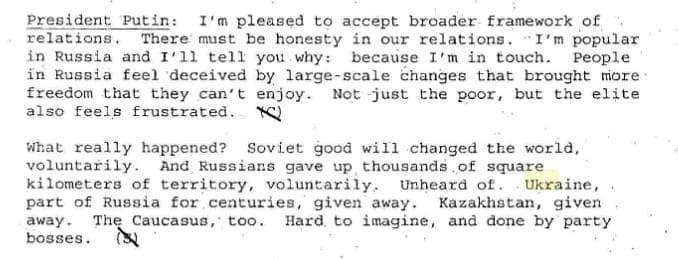
On June 16, 2001, during a conversation with Bush, Putin remarked on the historical context of Ukraine"s territorial changes, stating, "What actually happened? The Soviet Union’s goodwill changed the world voluntarily." He emphasized that Russia had "voluntarily" relinquished vast territories, including Ukraine, Kazakhstan, and parts of the Caucasus, a move he described as "unheard of." Putin noted that these territories had been part of Russia for centuries, indicating a deep-rooted historical connection. In a later conversation on April 6, 2008, Putin elaborated on his views regarding Ukraine, asserting that it was an "artificial state." He warned Bush that Ukraine"s potential accession to NATO could lead to "a long-term confrontation" between Russia and the West. Putin pointed out that approximately 17 million Russians lived in Ukraine, constituting about one-third of the country"s population. He characterized Ukraine as a "very complex country," suggesting that its formation was not a natural process but rather a product of Soviet-era policies. Putin provided historical context to his claims, explaining that after World War II, Ukraine acquired territories from neighboring countries such as Poland, Romania, and Hungary, which now comprise a significant portion of western Ukraine. He also noted that in the 1920s and 1930s, Ukraine received territories from Russia, particularly in the eastern regions. Furthermore, he mentioned the transfer of the Crimean Peninsula to Ukraine in 1956, a decision that has since become a contentious issue in Russian-Ukrainian relations. The Russian president highlighted the cultural diversity within Ukraine, stating, "People with very different views live there." He illustrated this point by contrasting the western and eastern parts of the country, where different languages and cultural practices prevail. In western Ukraine, he noted, some villages exclusively speak Hungarian, while in the east, residents tend to dress in business attire. Putin concluded his remarks by asserting that "the majority of the Ukrainian population perceives NATO as a hostile organization," reflecting the prevailing sentiment in Ukraine regarding Western military alliances.
Background
These conversations between Bush and Putin occurred during a pivotal time in international relations, particularly concerning NATO"s expansion and its implications for Eastern Europe. The discussions shed light on Russia"s perspective on Ukraine and its historical ties to the region. The characterization of Ukraine as an "artificial state" has been a recurring theme in Russian rhetoric, particularly in light of the ongoing conflict between Russia and Ukraine that escalated in 2014 with the annexation of Crimea. The National Security Archive"s release of these transcripts provides valuable insight into the mindset of Russian leadership during a critical period in post-Soviet history. It also underscores the complexities of national identity and territorial integrity in the context of former Soviet republics.
What"s Next
The implications of these revelations are significant, particularly as tensions between Russia and Ukraine continue to simmer. The characterization of Ukraine as an "artificial state" may influence ongoing discussions regarding NATO"s role in Eastern Europe and the West"s approach to Russian aggression. As previously reported, the geopolitical landscape remains fraught with challenges, and understanding the historical context of these relationships is crucial for policymakers and analysts alike. For more on related developments, see our coverage on
recent developments in international relations.
![[Video] IDF eliminates key IRGC operative Hussein Mahmoud Marshad al-Jawhari in Lebanon](/_next/image?url=%2Fapi%2Fimage%2Fthumbnails%2Fthumbnail-1766677241901-y75izr-thumbnail.jpg&w=3840&q=75)
![[Video] Turkish President Erdoğan meets Sudan's Sovereignty Council Chairman al-Burhan in Ankara](/_next/image?url=%2Fapi%2Fimage%2Fthumbnails%2Fthumbnail-1766671853909-k4v48m-thumbnail.jpg&w=3840&q=75)