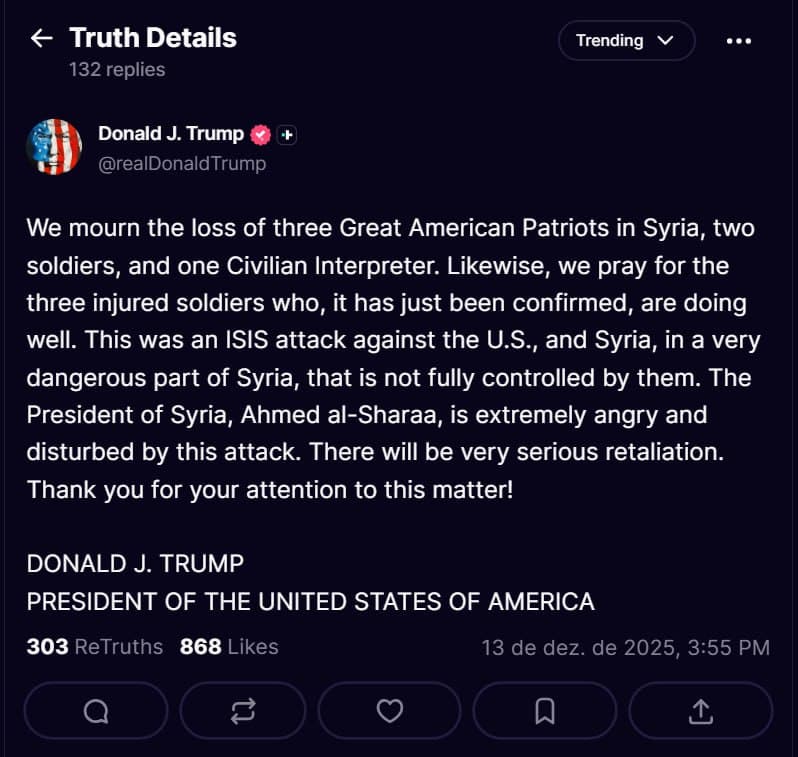
Trump Vows Retaliation Against ISIS After Attack in Palmyra Kills 3 Americans
On Saturday, December 13, 2025, United States President Donald J. Trump announced a commitment to retaliate against the Islamic State (ISIS) following a deadly attack in Palmyra, Syria, which resulted in the deaths of three Americans, including two U.S. Army soldiers and one civilian interpreter. The attack, described by President Trump as a targeted assault against U.S. forces, occurred in a region of Syria that remains perilous and is not fully under the control of ISIS.
Key Details
In his statement, President Trump expressed deep sorrow over the loss of the three individuals, referring to them as "Great American Patriots." He confirmed that three additional soldiers sustained injuries during the attack, but reassured the public that they are recovering well. The President"s remarks underscored the ongoing risks faced by U.S. military personnel operating in conflict zones like Syria, where ISIS continues to pose a significant threat.
The attack has drawn condemnation from various quarters, including Syrian President Ahmed al-Sharaa, who expressed his anger and disturbance over the incident. President al-Sharaa"s response highlights the complex dynamics of the Syrian conflict, where multiple factions vie for control and influence.
In his statement, President Trump emphasized that the U.S. would respond with "very serious retaliation" against ISIS, signaling a potential escalation in military actions against the terrorist organization. This response aligns with the U.S. government"s ongoing efforts to combat ISIS and ensure the safety of American troops deployed in the region.
Background
The attack in Palmyra is part of a broader context of violence and instability in Syria, where ISIS has been known to operate despite significant territorial losses in recent years. The U.S. has maintained a military presence in Syria, primarily to support local forces in the fight against ISIS and to stabilize the region. The situation remains complicated by the involvement of various international actors and local militias, each with their own agendas.
Palmyra, a city with historical significance, has been a focal point in the conflict, experiencing multiple shifts in control between government forces and ISIS fighters. The region"s instability poses challenges for both military operations and humanitarian efforts, as civilians continue to suffer amid the ongoing violence.
What"s Next
As President Trump prepares for a potential military response, the implications of this attack may reverberate throughout U.S. foreign policy in the Middle East. The commitment to retaliate against ISIS could lead to increased military operations, which may further complicate the already volatile situation in Syria. The U.S. government will likely coordinate with its allies and local partners to formulate a strategic response aimed at dismantling ISIS"s operational capabilities.
In the wake of this attack, discussions surrounding U.S. military engagement in Syria are expected to intensify, with lawmakers and military officials assessing the best course of action to protect American lives and interests. The situation remains fluid, and developments will be closely monitored as the U.S. navigates its response to this tragic incident.
For more information on the implications of this attack, see our related coverage on President Trump"s vow for retaliation against ISIS.
![[Video] Terrorist attack at Bondi Beach kills 10, injures dozens during Hanukkah event](/_next/image?url=%2Fapi%2Fimage%2Fthumbnails%2Fthumbnail-1765707643006-2pk18t-thumbnail.jpg&w=3840&q=75)