Diosdado Cabello Plans Coup Against Interim President Delcy Rodríguez
In a significant political development in Venezuela, Diosdado Cabello, a prominent figure within the ruling regime, is reportedly planning a coup d"état against Delcy Rodríguez, the interim president of the Venezuelan government. This information has surfaced amid growing discontent among high-ranking military officials regarding Rodríguez"s leadership.
Key Details
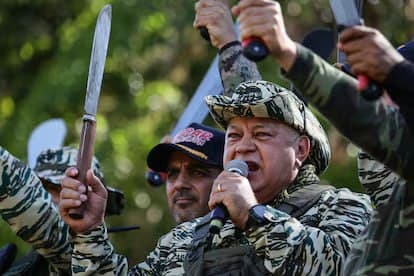
Diosdado Cabello is widely regarded as the right-hand man to President Nicolás Maduro and holds considerable influence within the Venezuelan political landscape. His control extends over various colectivos, which are far-left paramilitary groups that often operate with a degree of autonomy from the central government in Caracas. These groups have been known to engage in violent confrontations and have played a crucial role in maintaining the regime"s grip on power.
Delcy Rodríguez, who has served as the interim president, has faced criticism from numerous generals within the Bolivarian Armed Forces of Venezuela (FANB). The dissatisfaction among military leaders may be a contributing factor to Cabello"s alleged intentions to orchestrate a coup. The internal dynamics within the military and the ruling party are crucial in understanding the potential for political upheaval in the country.
Reports indicate that the tensions have escalated to a point where a faction within the military is seeking to challenge Rodríguez"s authority. The Bolivarian Armed Forces have historically been a pillar of support for the Maduro regime, and any significant dissent from within could have far-reaching implications for the stability of the government.
Background
The political climate in Venezuela has been fraught with challenges, including economic collapse, widespread protests, and international sanctions. The country has experienced significant turmoil since the onset of the crisis, which has seen millions of Venezuelans fleeing the nation in search of better living conditions. The internal power struggles within the ruling party and the military reflect the broader instability affecting the nation.
Cabello"s influence is not only political but also extends to the armed groups that have been deployed throughout Venezuela. These pro-Maduro militias have been a critical component of the regime"s strategy to suppress dissent and maintain control over the populace. The presence of these groups has been documented in various reports, highlighting their role in patrolling the streets and responding to protests.
What"s Next
The potential coup led by Cabello could lead to a significant shift in Venezuela"s political landscape. If successful, it may result in a reconfiguration of power within the ruling party and could further destabilize the already fragile situation in the country. The implications of such a move could be profound, not only for the Venezuelan people but also for regional stability.
As previously reported, armed clashes have been noted near the Miraflores area in Caracas, indicating rising tensions within the capital. The situation remains fluid, and the international community is closely monitoring developments as they unfold. For more on the recent developments in Venezuela, see our coverage on FANB soldiers spotted armed in Caracas and pro-Maduro militias deployed throughout Venezuela.